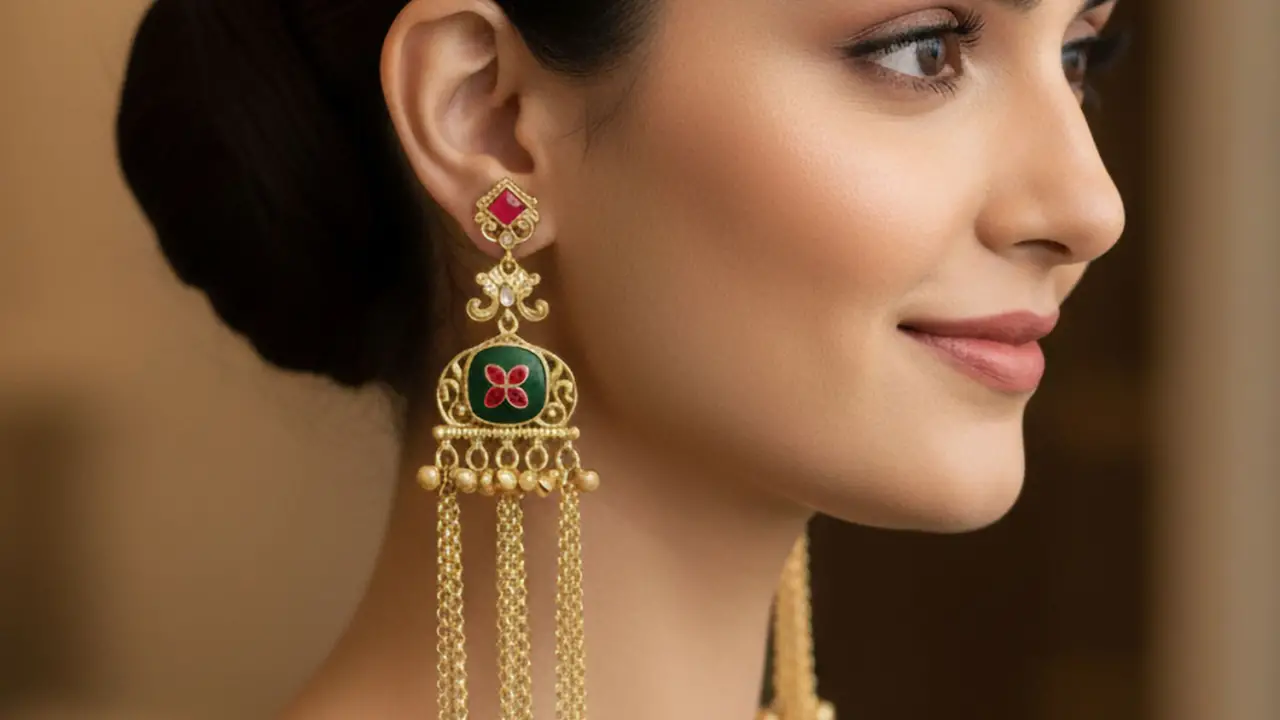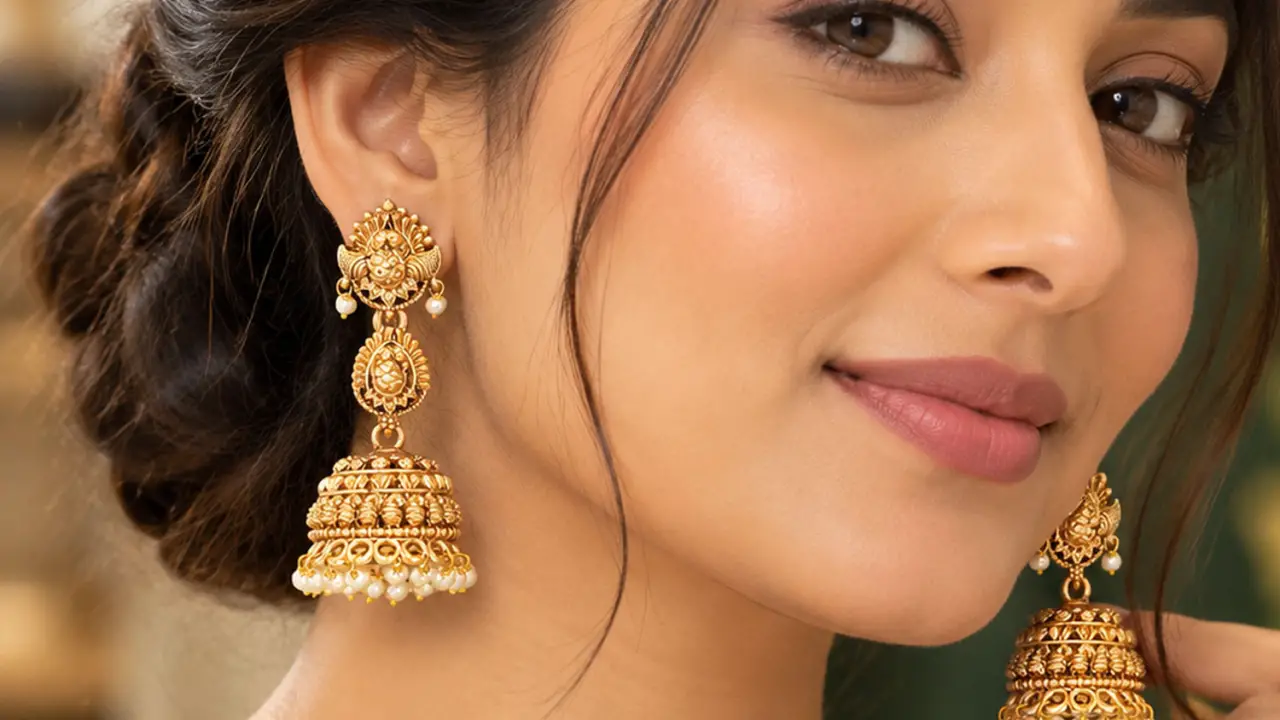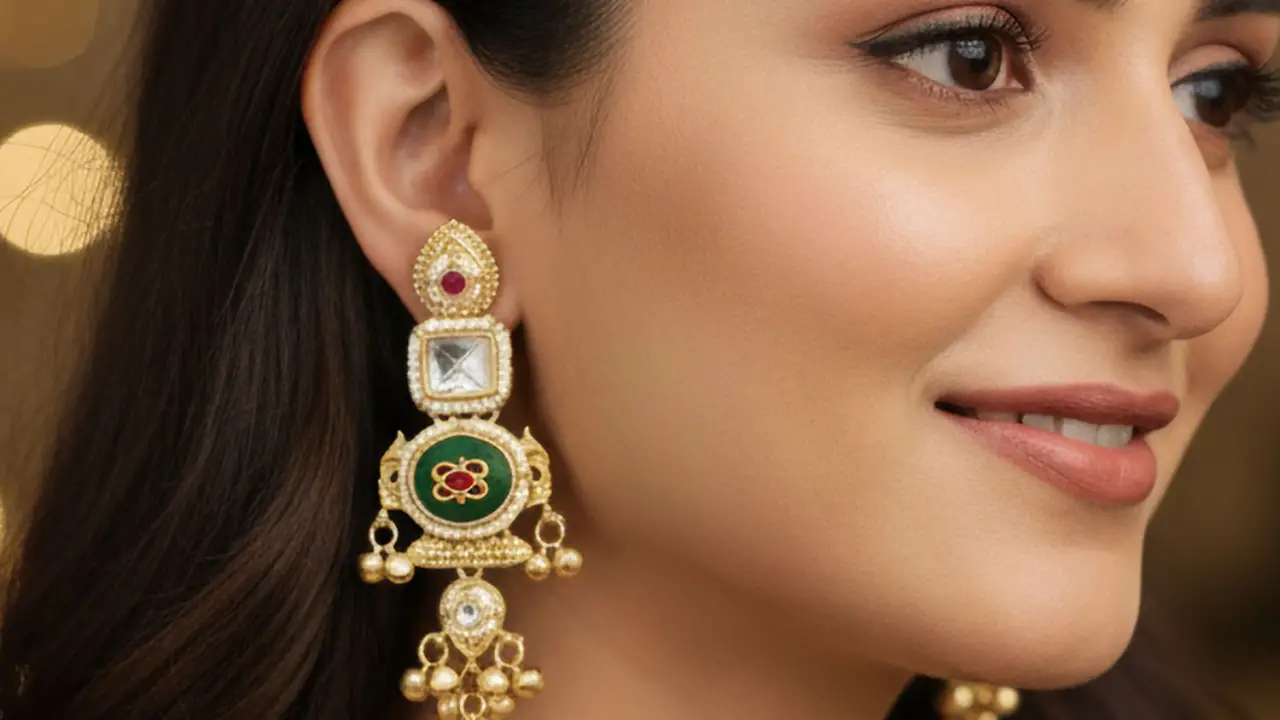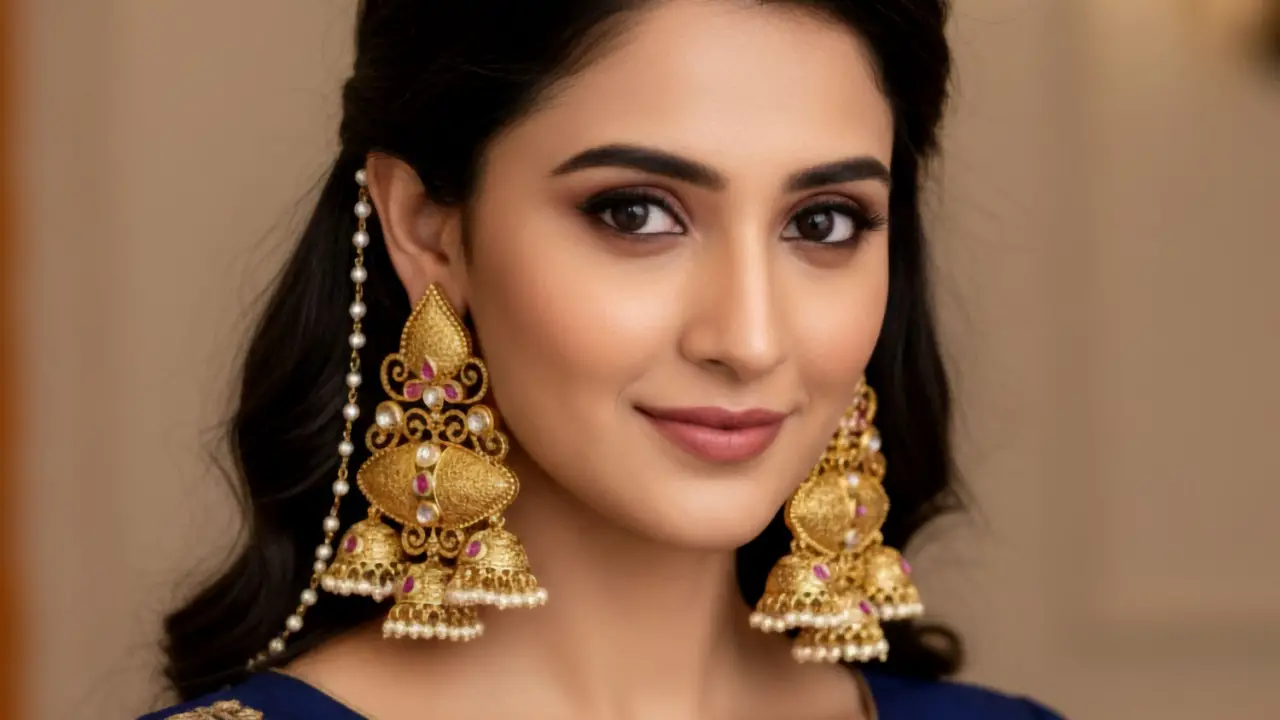
You see a pair you like, but the search bar wants a name. Is it a jhumka or a chandbali? A bali or a hoop? Is that a drop or a dangler? Earring names overlap, and Indian and English words often describe the same shape.
This guide sets out the main types of earrings, with their Indian and English names, what each looks like, how it fastens and what it goes with. It also explains earring backs, length and weight, and tells you plainly which types we list and which we do not.
Short answer
There is no fixed count of earring types, because guides group them differently. Most agree on a core set: studs, hoops, huggies, drops, danglers, climbers and ear cuffs. Indian wear adds the jhumka, chandbali, bali and ear chain. Pick the type by outfit and neckline, then check the weight and the back on the product page.
Key takeaways
- A stud sits on the lobe, a hoop forms a ring, and a drop or dangler hangs below the lobe.
- A jhumka has a bell shape, a chandbali a crescent, and a bali is a small ring.
- The back matters as much as the front: push, screw and hook fittings behave differently.
- Longer and larger earrings usually weigh more, so read the weight listed on the product page.
- Names overlap between shops, so use the photo and the description, not the title alone.
Types of earrings at a glance
This table is the quick reference. It lists the type, how it looks, the fastening you would usually expect and what it goes with. Fastenings differ between products, so treat that column as a general guide and check the listing.
| Type | What it looks like | Usual fastening | Goes with |
|---|---|---|---|
| Stud (tops) | One stone, pearl or motif sitting on the lobe | Post with a push back | Office wear, kurtas, a heavy necklace |
| Jhumka | Dome on top, bell-shaped drop below | Post and back, sometimes a hook | Sarees, suits, festive looks |
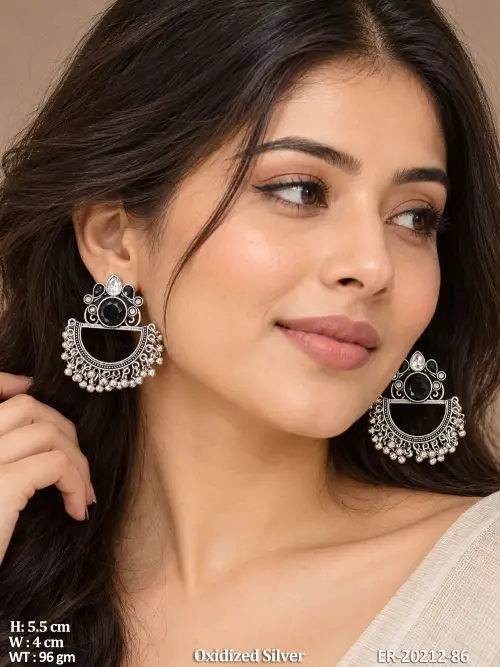
| Chandbali | Crescent or moon-shaped frame with a fringe of drops | Post and back | Bridal and festive outfits, lehengas |
| Bali | Small ring that follows the ear | Hinged or snap closure | Daily wear, kurtas, sarees |
| Hoop | Larger ring, thin to bold | Hinged, snap or hook | Western wear, modern drapes |
| Huggie | Small hoop that hugs the lobe | Hinged closure | Everyday and stacked looks |
| Drop | A stone or motif hanging just below the lobe | Post, hook or lever | Dresses, sarees, evening |
| Dangler | Longer, with more movement and tiers | Post, hook or lever | Deep necks, party wear |
| Ear chain (sahara, kaan chain) | A chain from the earring to the hair | Hook or pin into the hair | Heavy jhumkas, bridal looks |
| Climber | Curves upward along the ear | Post, sometimes with a second hook | Modern, minimal outfits |
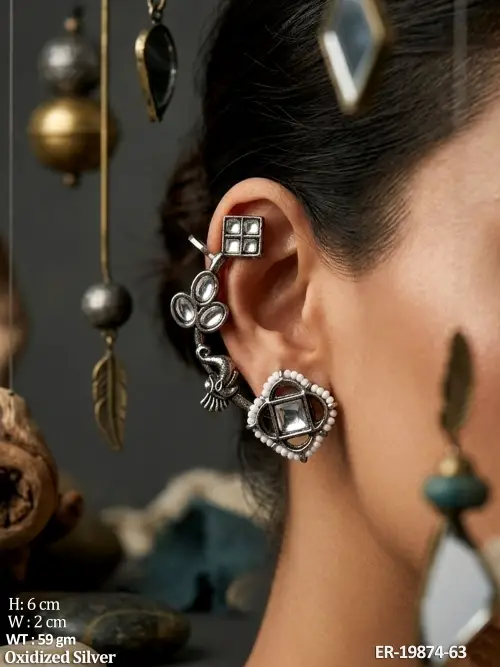
| Ear cuff | Wraps the rim of the ear | Wraps or clips on, no piercing needed | Casual and western looks |
Sources differ on some boundaries, especially between a drop and a dangler, so a shop may use either word for the same pair.
How many types of earrings are there?
Ask five guides and you will get five lists, from about six types to twenty. The core is shared: studs, hoops, huggies, drops, dangles, chandelier styles, climbers and cuffs. Indian wear then adds names that English lists often skip.
Indian earring names
Four Indian names cover most of what you will meet on shopping pages: jhumka, chandbali, bali and the ear chain.
Jhumka
Jhumkas range from small daily pairs to long, ornate ones with pearls or stones. Small ones suit office and daily wear, while large ones are festive.
The weight rises quickly with size. If you plan to wear a large pair for hours, read our guide to heavy jhumkas first. Our jhumka earrings page lists many sizes and finishes.
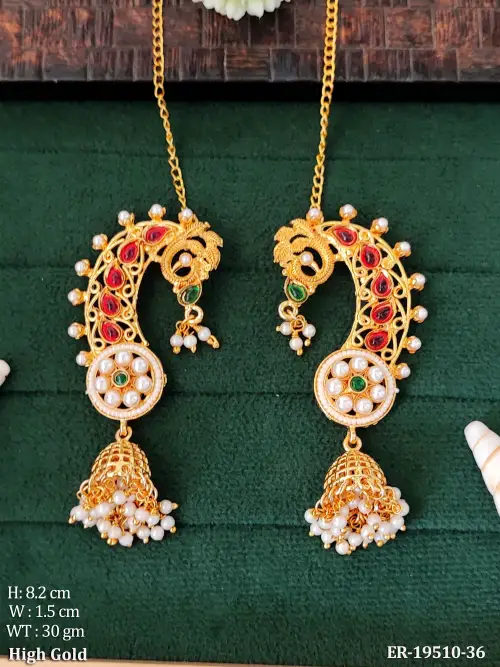
Chandbali
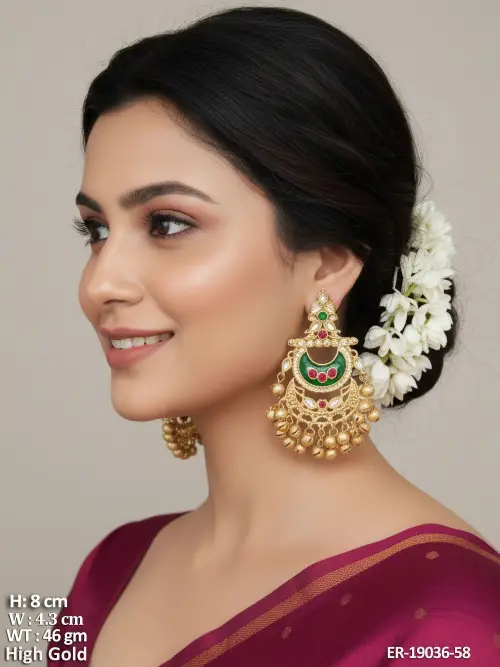
People often mix up the two, so here is the simple difference. A jhumka hangs as a bell, while a chandbali spreads out as a crescent. A chandbali sits wider and flatter against the face, which is why it is popular with lehengas and bridal outfits. Some designs combine both, with a crescent top and a bell below.
We do not have a separate chandbali category page, so look for them inside earrings. The earring-for-face-shape guide has a short jhumka or chandbali comparison if you are choosing between the two.
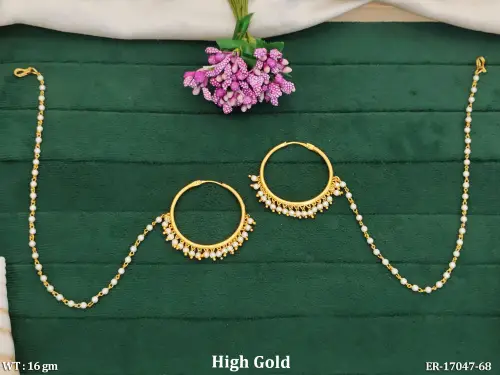
Bali
A bali is the Indian name for a hoop, though in practice people use it for the smaller, daintier ones, and "hoop" for larger, bolder rings. Some balis add a bell below, which makes a bali-jhumka, and some carry a small chain at the back.
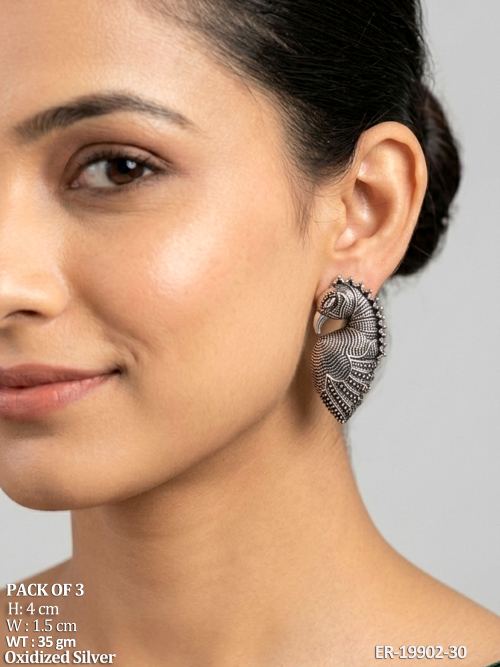
Ear chain, sahara and kaan chain
Strictly, an ear chain is an add-on, but many earrings now come with one attached. You will find these under kaan chain earrings. They are usually styled with hair in a bun or a braid, where the chain has something to hold. We cover how to fix one in the heavy jhumka guide.
English earring names
Stud and hoop: the basic difference
A stud sits directly on the lobe. The ornament is on a short post that goes through the ear and is held by a back. A hoop is a ring that passes through the ear and loops around, making a circle or a half circle. In India, studs are also called tops, and our studs and tops page has stone, pearl and motif styles.
A stud is the quiet choice, and a hoop adds a line around the ear.
Huggies
A huggie is a small hoop that hugs the earlobe instead of hanging away from it. Guides describe them as a mix of stud and hoop. We do not list a separate huggie type, so the closest match is a small hoop or a bali.
Drop, dangle and chandelier
A drop has an ornament that hangs just below the lobe and stays fairly still. A dangler is longer and moves more, and a chandelier is a tiered dangler with several levels. We list drops and danglers, mostly in stone, pearl and oxidised finishes.
Our face shape guide shows which lengths flatter which faces.
Climbers and ear cuffs
A climber curves upward along the edge of the ear, and an ear cuff wraps around the outer rim. Guides say an ear cuff needs no piercing, because it holds by wrapping or clipping on. If you are thinking of a new piercing, ask a professional piercer. We list ear cuffs in small numbers, in stone and oxidised styles, plus a few climbers. Stock moves quickly, so check the listing.
Earring backs and fastenings explained
The back decides how secure a pair feels, and how easy it is to put on. Guides describe these common types.
| Back | How it works | Usually found on |
|---|---|---|
| Push back (butterfly) | A small piece slides on to the post and grips by friction | Studs and many jhumkas |
| Screw back | The back is turned on to a threaded post | Studs, where a firmer hold is wanted |
| Lever back | A hinged hook closes over the ear | Drops and danglers |
| Hinged or snap closure | The ring opens and clicks shut | Balis, hoops and huggies |
| Hook (French wire) | A curved wire passes through the ear | Light danglers |
| Clip-on and ear screw | Presses on the lobe, so no piercing is needed | Non-pierced styles |
Push backs are the most common and are easy to use, though guides note they can loosen with time. Screw backs hold more firmly but take longer to fasten.
Our product data does not list the back separately. Look at the photos and the description, and if it is unclear, ask us on the contact page. We do not list clip-on or screw-back earrings as a separate type, but the guide to jewellery without piercing explains the options for ears that are not pierced.
Length and weight
Earrings fall into three rough lengths. Short ones sit at or above the jaw, medium ones end near the collarbone, and long ones reach the shoulder. A stud is short, and a chandbali or dangler is usually medium to long.
Weight is harder to guess from a photo. Larger, longer and more ornate pairs usually weigh more, but a hollow dome can be lighter than it looks. Read the weight on the product page, and compare it with a pair you already wear. If a pair is heavy, an ear chain can share the load, as the heavy jhumka guide explains.
How to choose a type
Start with the outfit, then the neckline, then the occasion. Picture a woman in a plain cotton saree for a family lunch. Small jhumkas or balis fit well, since the saree is calm and the earring can lead. Picture the same woman at an evening reception in a heavy lehenga. A chandbali, possibly with an ear chain, balances the outfit.
For western outfits, hoops, studs and ear cuffs work well, and our western earrings page lists them.
Face shape can help to narrow the list, and our earrings for face shape guide covers it. For care, see how to clean kundan, pearl, AD and antique jewellery and how to store jewellery without tangles.
Where to start looking
Browse all earrings, or jump to jhumkas, studs and pearl earrings. If a pair does not suit you, our returns policy allows returns within 2 days.
Frequently asked questions
How many types of earrings are there?
There is no fixed number. Guides list anywhere from about six to twenty, depending on how they group styles. A common core is studs, hoops, huggies, drops, dangles, chandeliers, climbers and cuffs. Indian wear adds the jhumka, chandbali, bali and ear chain.
What is the difference between a stud and a hoop?
A stud has an ornament on a short post that sits on the lobe. A hoop is a ring that loops through the ear. Studs look neat and small, while hoops add a visible line around the ear. In India, studs are also called tops.
What is a jhumka earring?
A jhumka has a dome at the top and a bell-shaped drop below. The name is generally understood to mean a bell. Jhumkas come small for daily wear and large for festive looks, and heavier pairs are often worn with an ear chain.
What is the difference between a chandbali and a jhumka?
A chandbali is built on a crescent or moon shape, usually with small drops along the lower edge. A jhumka hangs as a bell. Some designs combine a crescent top with a bell.
What is a drop or dangler earring?
A drop hangs just below the lobe and stays fairly still. A dangler is longer and moves more, sometimes with tiers. Guides use the two words differently, so rely on the product photo and the listed length rather than the word alone.
What are huggie earrings?
Huggies are small hoops that hug the earlobe closely, usually with a hinged closure. They sit between a stud and a hoop. We do not list them as a separate type, so a small bali or hoop is the closest match in our range.
What is an ear cuff, and does it need piercing?
An ear cuff wraps around the outer rim of the ear. Guides describe it as a style that needs no piercing, since it holds by wrapping or clipping on. For anything involving a new piercing, ask a professional piercer. We list ear cuffs in small numbers.
Which earrings suit a round, oval or heart-shaped face?
Guides give options, not rules. Many suggest longer drops for a round face, almost any style for an oval face and designs that are fuller at the bottom for a heart-shaped face. Our face shape guide goes through each, with Indian styles, so we do not repeat it here.
Which earring types suit a lehenga or a saree?
For a lehenga, many people choose a chandbali, a long jhumka or a dangler with a lighter necklace. For a saree, jhumkas, balis and medium drops are common picks, and studs suit a heavily worked saree. Pick one lead piece and keep the rest quieter.
What are earring backs, and which should I look for?
The back is the part that holds the earring in place. Common types are push backs, screw backs, lever backs, hinged closures and hooks. Push backs are easy, while screw backs hold more firmly. Look at the photos and ask us if the back is unclear.
What is the difference between clip-on and screw-back earrings?
Clip-ons press on to the lobe and are made for ears that are not pierced. Screw-backs are turned on to a threaded post and are used with pierced ears. We do not list clip-ons as a type, so check each page.
Which earrings are the lightest?
Small studs and small balis are usually lighter than long jhumkas or chandbalis, but size is only a guide. A hollow design can weigh less than it looks. Check the weight on the product page and compare it with a pair you already wear.
Sources
- Gabriel & Co.: Different types of earrings and earring backs (studs, hoops, huggies, drops, dangles, chandeliers, cuffs, climbers, back types)
- Wikipedia: Earring (pierced and non-pierced types, studs, hoops, huggies, clip-ons, ear cuffs)
- Exotic India: Meet Jhumka (bell shape and the meaning of the name; its dates are not repeated here because the page gives no sources)
- Aurus: Chandbali earrings (chand and bali, the crescent shape)
- Elle India: The ear chain (sahara or kaan phool, links the ear to the hair, supports heavier earrings)