You search for a South Indian necklace set and the product titles start to blur. One says temple, the next says kemp, and a third says antique, and the photos look alike. Many shoppers assume they are three names for one thing, and others assume they must choose between them.
The truth sits in between. If you want to know what temple jewellery is, and how it differs from kemp and antique pieces, the short version is that the three words answer three different questions. This guide explains each word, shows how to read real product titles from our catalogue, and sets out what we do and do not say about history.
Short answer
Temple jewellery is a South Indian look built on motifs such as Lakshmi, peacocks and lotus petals. Kemp jewellery is named for its red stones, often with green. Antique is a finish, a warm aged-looking surface. One piece can carry all three words, because they describe motif, stone and surface.
Key takeaways
- Ask three questions of any piece: what is drawn on it, what colour are the stones and how does the metal look.
- Temple points to the motif, kemp to the stones and antique to the finish, so they overlap more than they compete.
- Antique describes a surface and says nothing about age. Our pieces are new, made in India on a metal alloy base with artificial stones.
- Shops and sources disagree on whether temple and kemp mean the same thing, so read the photo with the title.
- Match the finish across your pieces and the name matters much less.
Three words, three questions
The easiest way to stop mixing the words up is to stop treating them as rival categories. Treat each one as the answer to a separate question about a piece.
| Question | Word that answers it | Example of what you will see |
|---|---|---|
| What is drawn or shaped on it? | Temple | A Lakshmi figure, a peacock, lotus petals, a row of coins |
| What colour are the stones? | Kemp | Red stones, often with green, sometimes with pearls |
| How does the metal look? | Antique | A warm, low-shine, darker-in-the-grooves surface |
A single necklace can answer all three at once. That is why shoppers see the same piece listed under more than one name, and why a style that feels like three families is really one family with three labels. The style hubs on our site explain each page in detail, so here we concentrate on how the words work together. See temple jewellery, kemp jewellery and antique jewellery for the full ranges.
Reading real product titles
The fastest way to learn the vocabulary is to take real titles from our catalogue and read them word by word. The table shows what each title tells you, and what it leaves out.
| Title as listed | What it tells you | What you check in the photo |
|---|---|---|
| Bridal Temple Necklace Set for Women | Temple-led design, a larger set | The central motif and the finish |
| Kemp Necklace Set with Pearls in Matte Finish | Red-stone styling, pearls, a quiet surface | Stone colours and where the pearls sit |
| Antique Necklace Set in Matte Finish for Women | An aged-look surface with a soft shine | The motif, which the title does not name |
| Antique Temple Coin Necklace Set with Earrings | Temple design, a coin motif, an aged-look surface | How many coins and how large |
| Temple Necklace Set in Oxidised Finish for Women | Temple design in a darker, blackened surface | How dark the finish looks |
Two points stand out. First, an antique title does not describe the design, so read the photo for the motif. Second, a temple title does not describe the finish, so look for words such as matte, Rajwadi, high gold or oxidised. Reading both is quicker than it sounds, and it prevents most disappointments.
What history says, and what we do not claim
Temple jewellery has a long story, and it is easy to say too much about it. The Indian National Trust for Art and Cultural Heritage (INTACH) describes South Indian temple jewellery as originating in the Chola and Pandya dynasties, with early pieces made from precious metal donated to temples and meant for adorning deities and royalty. Many retail articles repeat this, sometimes adding dates and attributions we could not verify.
For kemp, a Kannada dictionary lists kempu as the colour red and also as a word for ruby. That fits the red stones, but the idea that the name comes from this word is repeated by sellers and we found no linguistic study behind it. Sources also disagree on whether kemp is a separate style or just another name for temple jewellery, and some treat it as the stone-setting style within the wider tradition.
Our pieces are modern, artificial jewellery. We describe the design, the stones and the finish, and we do not state the age, region of origin or religious meaning of any single piece. If you want to read about the traditions, the INTACH archive is a good place to start.
Temple jewellery: look at the motif
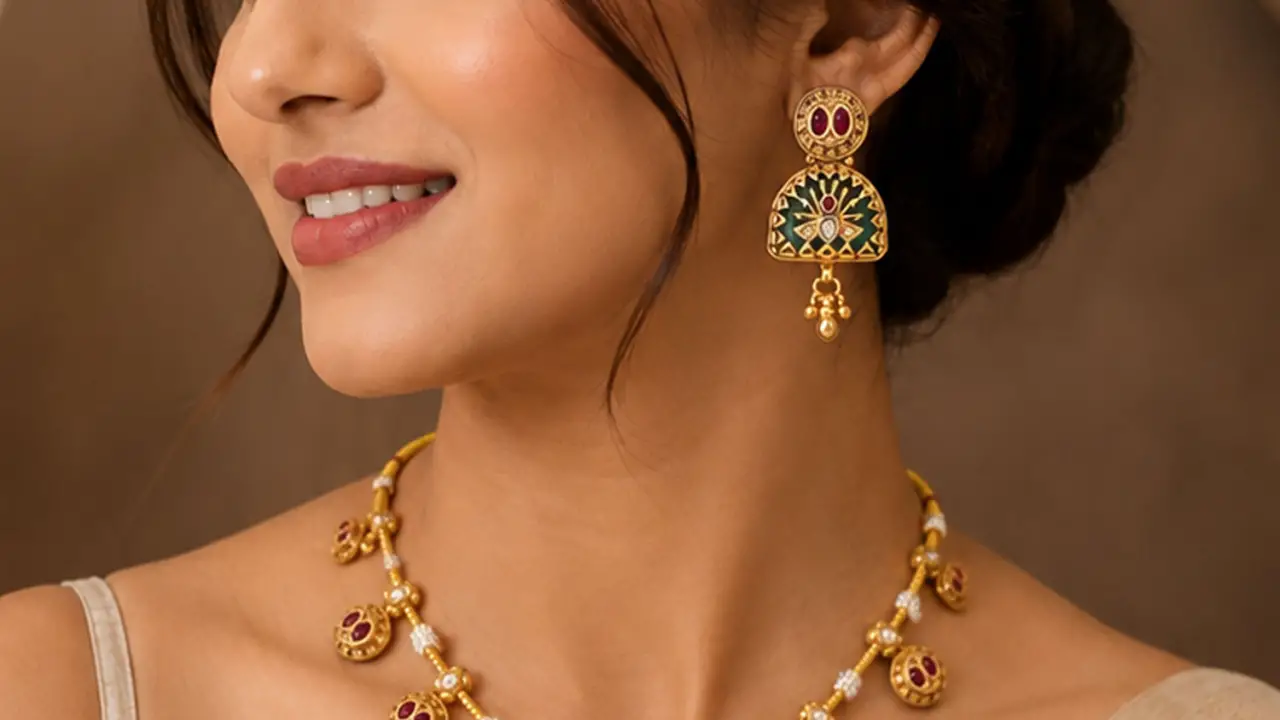
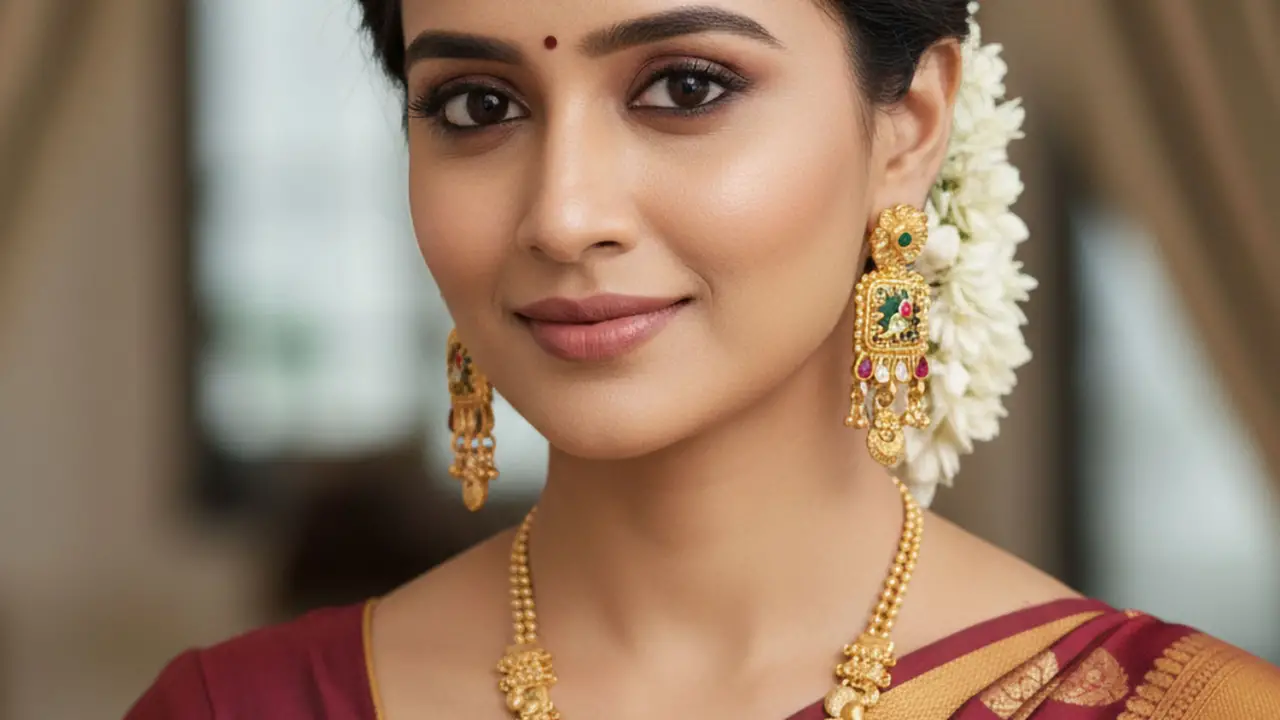
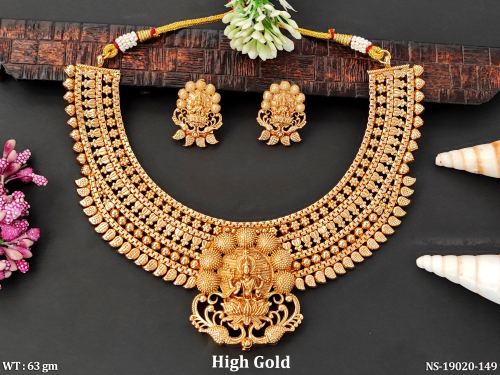
When a title says temple, the design is drawing on temple sculpture. The most common motifs on our pages are a Lakshmi figure, a peacock, lotus petals and rows of coins or beads. A temple piece is often a bold gold-tone, and it can be low-shine or bright depending on the finish.
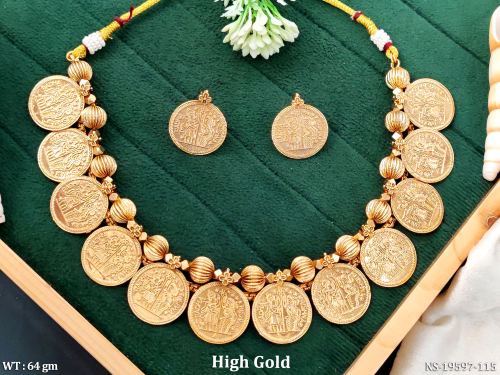
Not every temple piece has a figure. Many use flowers, peacocks, leaves and pearl clusters, so if you prefer a look without deity figures, scan the photos for those and skip titles that name a figure. A coin design is a good example of a motif you can recognise in a second.
For a coin-led design, look at a piece such as the one below, which pairs a coin necklace with matching coin earrings.
Temple necklaces sit well against silk, and our guide to choosing jewellery by saree and lehenga colour shows how to match the gold-tone to a border. For a narrower search, try temple necklace sets and temple earrings.
Kemp jewellery: look at the stones
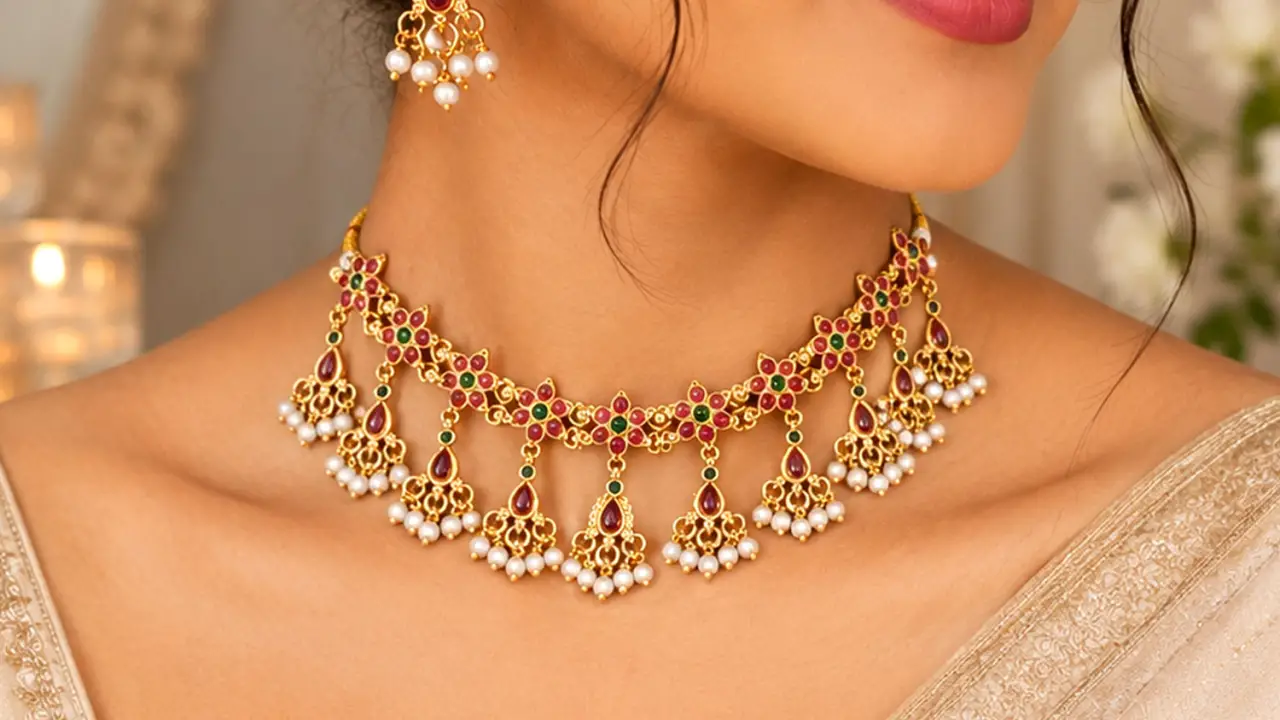
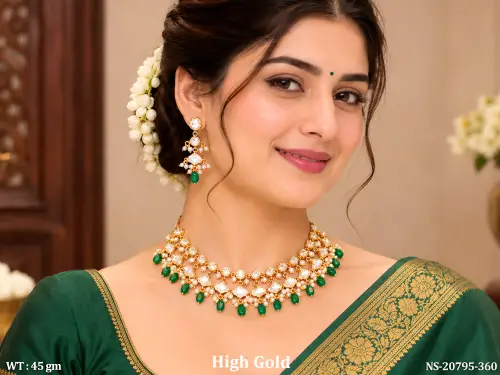
Kemp pieces are set with red stones, frequently alongside green, and many add pearls. The stones on our pieces are artificial (glass or fibre), set in a metal alloy base, and the colour you see in the photo is the colour of the stone as photographed. The finish is usually matte or Rajwadi, with fewer bright high-shine pieces.
Because kemp names the stones and not the finish, a kemp necklace can also be antique-finished, and it can carry temple motifs. When you see kemp in a title, check where the stones sit. A single large red stone makes a different statement from rows of small ones.
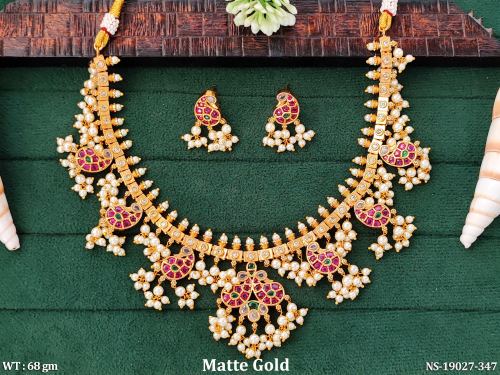
Browse kemp necklace sets for sets with earrings. If you wear your pieces with silk, a red or green blouse border is a natural partner for these stones.
Antique jewellery: a finish, not an age
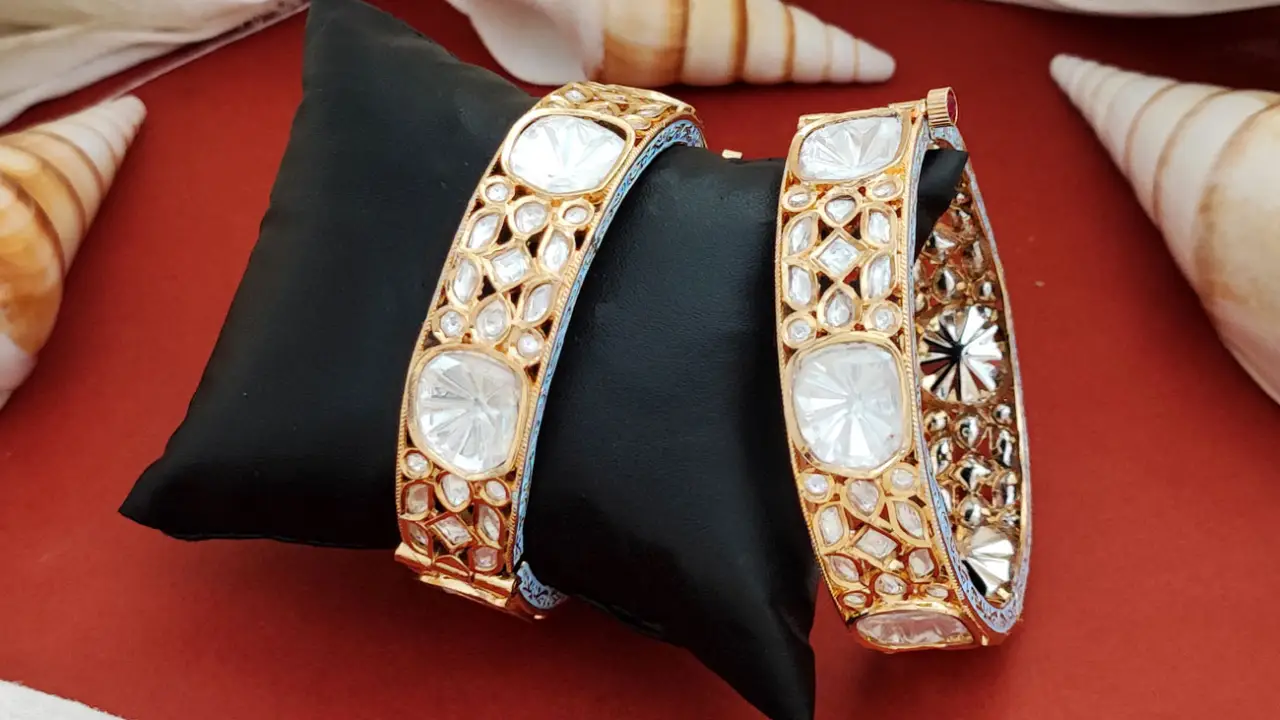
This is the word that confuses people most. In jewellery listings, antique describes a deliberately aged-looking surface, warm and low in shine, with darker recesses that make patterns look carved. It does not mean the piece is old. Everything we sell is new. Antique is also a finish that can run through a whole range, so it appears on necklaces, bangles, nath and payal alike.
The finish is separate from oxidised, which is a darker, more blackened surface. If you like the aged look but want it darker, see oxidised jewellery. If you like it warm, antique jewellery is the page. The finish is also why the antique range is so large: almost any design can be finished this way.
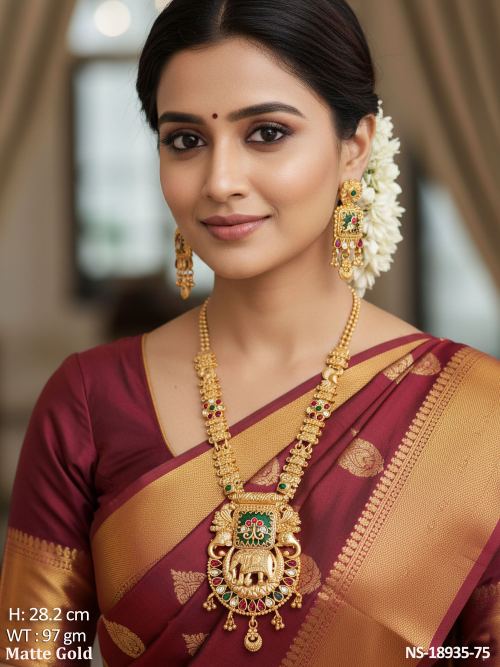
See antique necklaces for the necklace range. The finish is a surface colour in the photo, and no finish can be promised to stay the same forever. Our care guide for kundan, pearl, AD and antique jewellery explains how to wipe and store these pieces.
How to choose: three quick questions
If you are still undecided, answer these in order.
| Question | If yes | If no |
|---|---|---|
| Do you want a visible motif such as Lakshmi, a peacock or coins? | Start with temple designs | Look at kemp stones or a plain antique set |
| Do you want colour in the stones? | Choose kemp, or any piece with red and green | Choose antique or pearl pieces |
| Do you want quiet or shine? | Matte or antique for quiet, high gold for shine | Rajwadi sits between the two |
If the outfit is heavy silk, a temple or kemp set with a rich border looks traditional. If the outfit is light cotton, a slim antique pendant set is easier. Our guide to jewellery for cotton, georgette, organza and net sarees covers lighter fabrics.
Can you mix temple, kemp and antique?
Yes, and the rule is easy. Match the finish, not the name. Antique bangles with a temple necklace and kemp earrings can look coordinated if all three share a warm, low-shine surface. Mixing a bright high-shine piece with a matte one makes the matte piece look dull by comparison, so keep the finish consistent.
Keep one statement piece, and let the others stay smaller. A heavy temple necklace pairs with studs, and a bold pair of kemp jhumkas pairs with a slim chain. For a full range, browse necklace sets.
Frequently asked questions
What is temple jewellery?
Temple jewellery is a South Indian look whose designs echo temple sculpture, such as deity figures, lotus petals, peacocks and rows of coins or beads. INTACH describes it as originating in the Chola and Pandya dynasties. Our pieces follow the look in artificial form.
What is the difference between temple, kemp and antique jewellery?
Temple names the motif, kemp names the stones, and antique names the finish. They answer different questions, so one piece can carry all three words. A kemp necklace with temple motifs in an antique finish is a normal combination.
Is kemp jewellery the same as temple jewellery?
Not always. Some sources use the words as synonyms, while others treat kemp as the red-stone setting style within temple jewellery. In our catalogue, kemp names red and green stones, and temple names the sculptural motifs. Check the photo.
What does kemp mean in jewellery?
Kemp refers to red stones, often paired with green. A Kannada dictionary lists kempu as the colour red and as a word for ruby. Sellers say the name comes from that word, though we found no linguistic study. The stones on our pieces are artificial.
Is antique jewellery old?
No. Antique describes a finish, a deliberately aged-looking surface that is warm and low in shine. Everything on our site is new, made in India on a metal alloy base with artificial stones and faux pearls. The word says nothing about age or origin.
What is the difference between antique and oxidised jewellery?
Both are surfaces. Antique is warmer and looks aged in a golden way. Oxidised is darker and more blackened. A piece can have temple motifs in either finish, so check the photo to judge how dark or warm the surface looks.
Is temple jewellery made of real gold?
INTACH describes traditional temple pieces as made of precious metal, often gold. The temple jewellery we sell is artificial, made on a metal alloy base with artificial stones. The gold-tone colour is a surface finish, and the listing says so.
Can I wear temple jewellery with a lehenga?
Yes. Keep the rest of the jewellery plain and let one temple piece lead, such as a short set with a maang tikka. Temple pieces are most often worn with sarees, particularly silk, and they also suit festival outfits.
Which suits a wedding: temple, kemp or antique?
None outranks the others. Heavy silk looks traditional with a temple or kemp set, and an antique-finish set suits rich fabrics too. A guest needs one necklace set, and a bride often wants a fuller set. Choose by outfit and finish.
Can I mix temple, kemp and antique pieces together?
Yes. Match the finish and not the name. Antique bangles, a temple necklace and kemp earrings look coordinated when they share a warm, low-shine surface. Avoid mixing bright high-shine pieces with matte ones, because the matte piece looks dull.
How do I look after temple, kemp and antique jewellery?
Keep each piece dry and away from perfume and hair spray, and put it on after you dress. Wipe with a soft dry cloth and use a soft brush around the stones. Store pieces separately in a pouch so stones do not scratch each other.