A silk saree already carries a lot. There is the weave, the zari border, the pallu, and often a colour that took you an hour to choose. Then comes the question of jewellery for a silk saree, and the usual answer, "wear a heavy set", does not help much when the saree itself is heavy.
This guide goes weave by weave. It covers Banarasi, Kanjivaram (also spelt Kanjeevaram or called Kanchipuram), Paithani, Patola, Tussar and Mysore silk, and shows which style of jewellery sits well with each. It follows a simple border and pallu rule, and it names what to skip. If your saree is cotton, georgette, organza or net, read our companion guide for lighter fabrics instead.
Short answer
For a silk saree, let the border and pallu set the tone and add one necklace set with earrings. Banarasi suits kundan or antique pieces, Kanjivaram suits temple jewellery, and Paithani suits peacock and pearl accents. Match the metal tone to the zari, and keep bangles modest.
Key takeaways
- Read the border and pallu first, because they are the busiest parts of a silk saree and decide how much the neck can carry.
- Match the tone of the zari: a warm yellow zari wants warm-toned jewellery, and a cool white zari wants cool-toned pieces.
- Pick the jewellery family by weave: kundan or antique for Banarasi, temple for Kanjivaram, peacock and pearls for Paithani.
- One necklace set with matching earrings is usually enough, and a second neck piece tends to crowd a rich pallu.
- Plain, softer silks such as Mysore or Tussar can carry a slightly bolder set than a brocade can.
The border and pallu rule
Most silk sarees are plain or lightly worked in the body, and rich at the border and pallu. That is where your eye goes first, so it is also where your jewellery gets compared. We use three small checks before choosing anything.
- Read the zari. Is the metallic thread warm yellow, or a cool white? Pick a metal tone that repeats it.
- Size the necklace to the pallu. A broad, densely worked pallu on the shoulder needs a slimmer necklace. A plain pallu leaves room for a fuller set.
- Take one colour from the border. If the border has a flash of green or pink, one stone in that shade ties the look together. Your whole set does not need to match it.
Pin the pallu first and put the necklace on afterwards. Then check in a mirror that the pin does not sit on the chain, because it tends to drag it sideways.
Silk saree jewellery at a glance
| Silk saree | How it looks | Jewellery family that sits well | Think twice about |
|---|---|---|---|
| Banarasi brocade | Dense zari motifs, often floral or leafy, a rich pallu | Kundan or antique set with matching earrings | A second heavy neck piece |
| Kanjivaram | Wide contrast border, bold pallu, temple-inspired designs | Temple jewellery, short or medium length | Very fussy, tiny-stone pieces that vanish |
| Paithani | Peacock pallu, jewel-bright colours | Peacock-motif temple pieces, pearl accents | Clashing coloured stones |
| Patola | Dense, colour-rich pattern across the body | A quiet antique or pearl set | Multi-colour stone sets |
| Tussar | Textured, matte, natural warm shade | Oxidised or antique pieces, beaded malas | High-shine, very polished sets |
| Mysore silk | Soft crepe feel, simple body, zari border | Pearls, a light kundan or antique set | An oversized necklace on a plain body |
Treat the table as a starting point, because the occasion matters as much as the weave.
Jewellery for a Banarasi saree
The Varanasi district administration describes Banaras brocade sarees as handloom silk textiles worked in zari on a jacquard loom, which makes them heavy. It also lists the usual designs: Mughal-inspired floral and leafy patterns such as kalga and bel, plus jali (net-like) work. Banaras Brocades and Sarees holds a Geographical Indication registration, with a certificate dated September 2009.
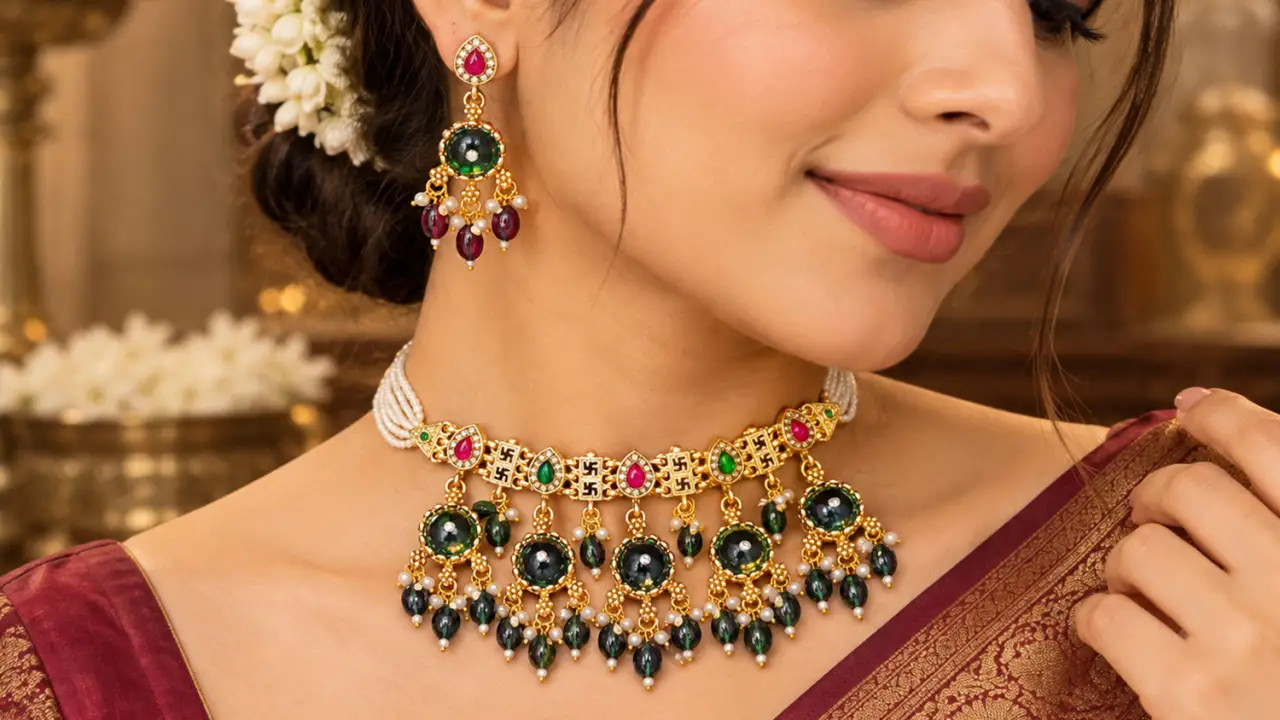
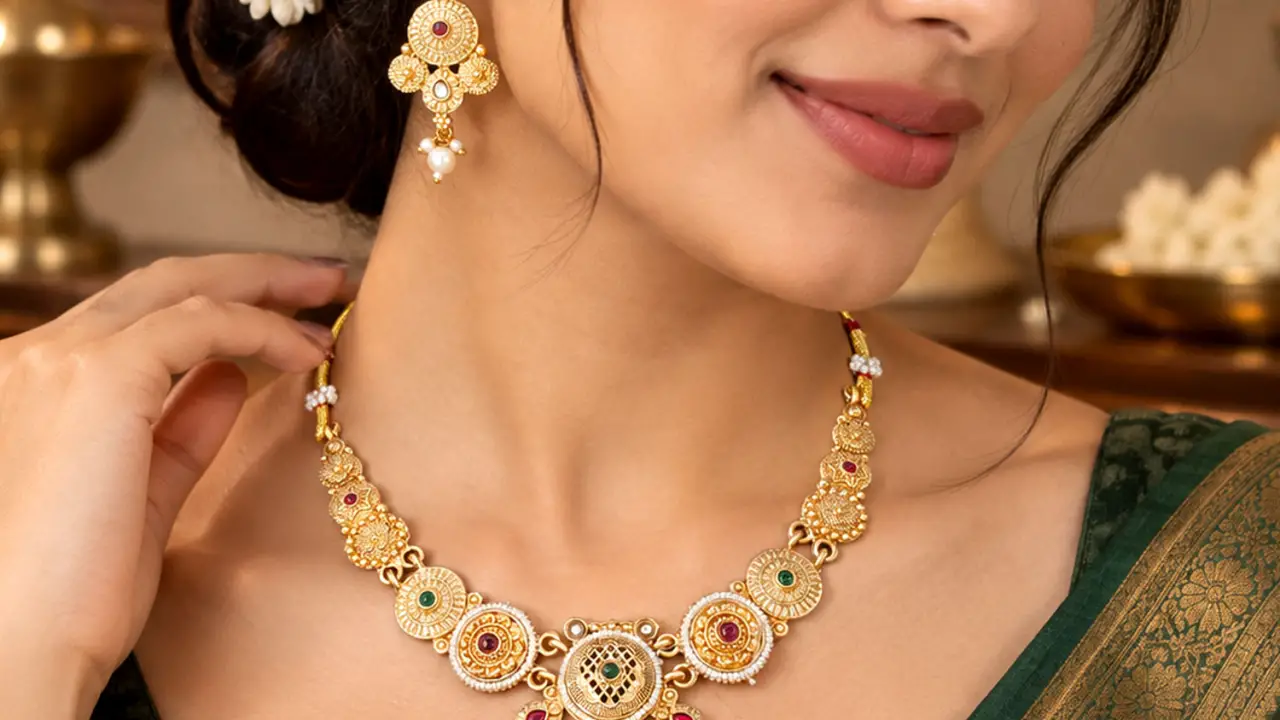
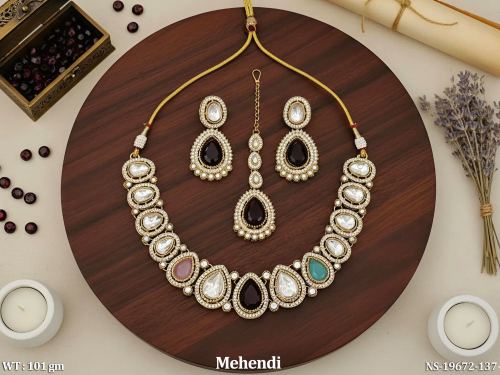
What that means for jewellery is easy to see. The saree is already dense, shining and detailed all over, so your set should have a clear shape rather than a lot of tiny detail. Kundan and antique styles are the classic partners because their stones and carved metal look settled against zari. Our kundan jewellery and antique jewellery pages carry sets that suit this.
Picture a maroon Banarasi with a warm yellow zari border, worn to a cousin's wedding. A kundan necklace set with a small green stone, matching earrings and a pair of slim bangles is plenty. The zari does the shining, so the jewellery stays tidy. For help with shades, our colour guide for sarees and lehengas covers red, green, blue and more.
Jewellery for a Kanjivaram saree
The Kancheepuram district page describes these sarees as having wide, contrasting borders, with named patterns such as Rudraksham (bead-like), Gopuram (temple tower) and Mayilkan (peacock eye). The pallu contrasts with the body and carries heavy zari. It adds that the body is woven separately from the border and pallu and then interlocked with them. Many weavers use the word korvai for that join, though the district page itself does not.
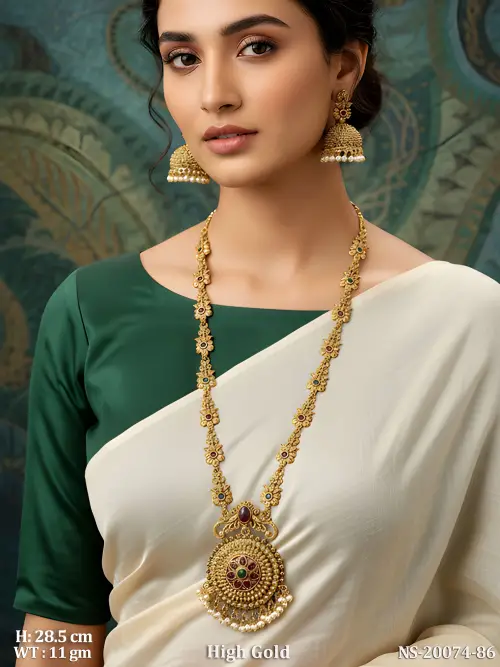
The strong contrast between body and border is the key detail for jewellery. Your eye moves between two colours, so the necklace should not add a third. Temple jewellery is the natural fit, because Kanjivaram borders and temple jewellery draw on the same architecture and the same deities. Our guide to temple, kemp and antique jewellery explains how the three styles differ, and you can browse the temple jewellery page directly.
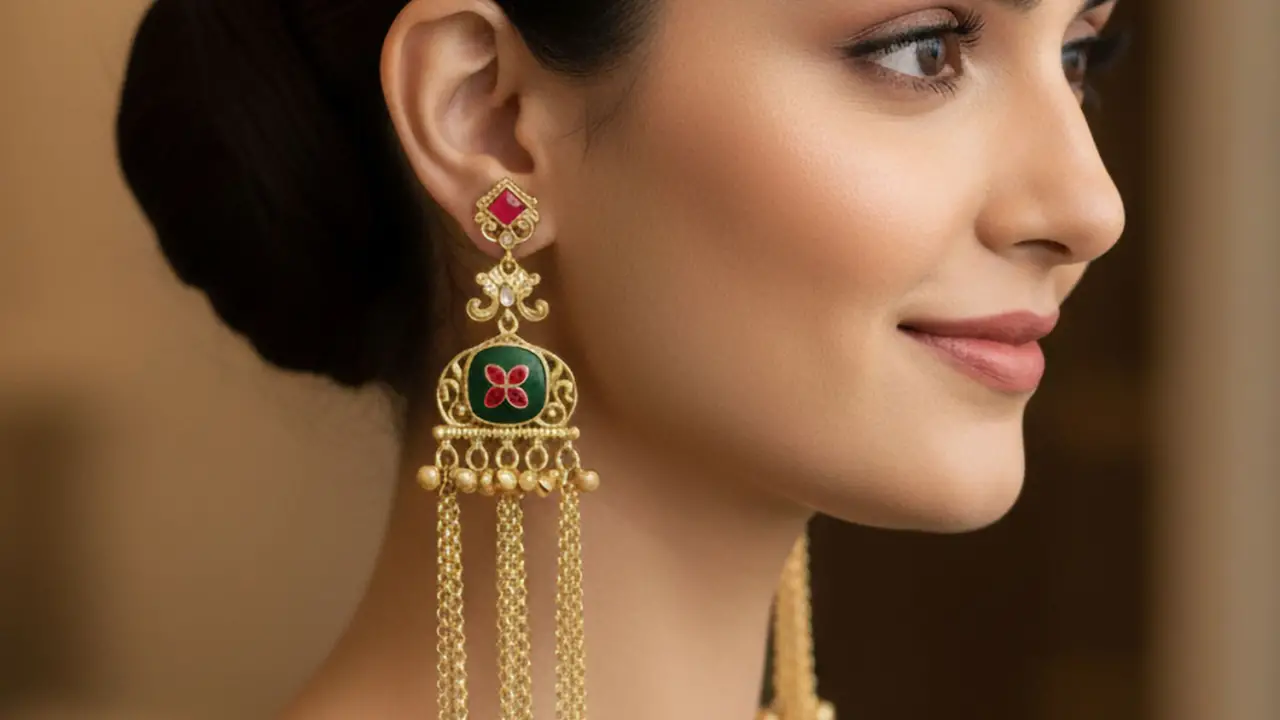
A short or medium temple necklace with matching jhumkas suits most Kanjivaram sarees. If the border is very broad, shorter is easier, because a long haram can lie across the border and fight it. Suppose you have a deep green saree with a magenta border. A temple set with one red or green stone repeats a colour you already have and keeps the neck calm.
Jewellery for a Paithani saree
Paithani takes its name from Paithan in Maharashtra, a trading and textile town written about since ancient times. Sahapedia's introduction to the handlooms of Maharashtra describes it as woven on a pit loom in silk and zari, with an oblique square design and a pallu featuring a peacock. Other sources also name Yeola near Nashik as a major weaving centre today.
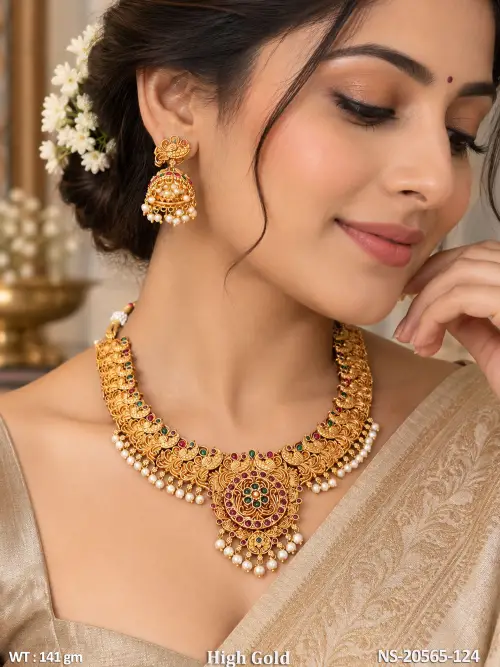
The peacock is the sign of a Paithani, and the saree tends to come in jewel-bright colours. That makes peacock-motif temple jewellery a pretty echo, and pearl accents a calm bridge between the colours. Keep the necklace proportionate so the pallu stays visible.
Paithani is also worn in the nine-yard Nauvari drape, and in Maharashtra it is often paired with traditional pieces such as a nath. If you want a nath without a nose piercing, our no-piercing guide explains the options.
Patola, Tussar and Mysore silk
Patola
Patan Patola is a double ikat. According to Drishti IAS, both the warp and weft yarns are tie-dyed before weaving, so the design and colour match on both sides of the cloth. It received a Geographical Indication in 2013, and preparing the dyed threads for one six-yard saree is said to take three to four months. Because so much pattern and colour is already in the cloth, we would pair it with a quiet antique or pearl set, and leave multi-colour stones for plainer sarees.
Tussar
Tussar comes from wild silkworms of the Antheraea family. It is coarser and more textured than cultivated silk, with a natural deep warm shade and a dull sheen. That earthy look suits oxidised or antique jewellery and long beaded malas.
Mysore silk
The GI application for Mysore silk, filed by the Karnataka Silk Industries Corporation, describes sarees on a crepe-de-chine or georgette base, with or without zari in the border, body and pallu. The soft fall and often plain body leave room for a light kundan or antique set, or a pearl necklace. An oversized set can overwhelm a simple body, so size it to the border.
A plain silk with a heavy border
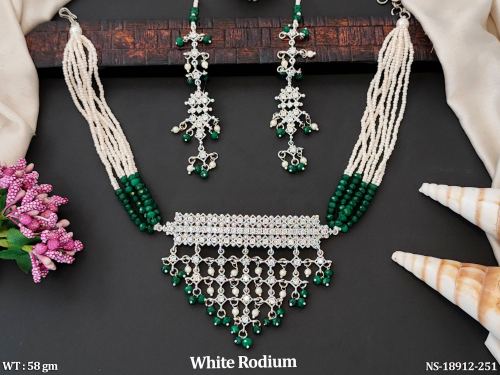
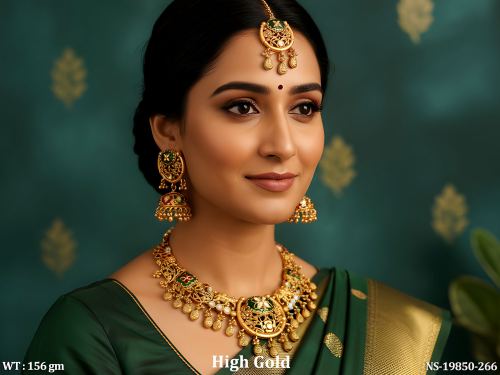
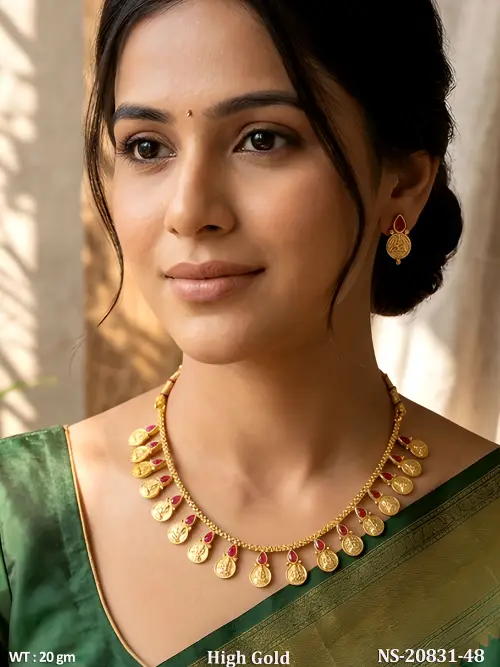
Many silk sarees, from Kanjivaram to tissue silk, have a plain body and a wide border. The border is already the decoration, and a dense necklace laid over it can look like two borders competing. Choose an antique necklace set with a clear shape and a medium length, and let the plain body breathe between the necklace and the border.
Check the neckline too. A boat neck, a high neck and a deep V each want a different necklace length, and our necklace and neckline guide shows the pairs. As a rule, a heavily worked blouse wants a simpler necklace.
How many pieces with a heavy saree?
For a wedding, a festival or an evening, a necklace set with earrings, a pair of bangles or one kada, and a ring is a full look. Add a maang tikka only if the occasion is a wedding function, and our maang tikka guide shows how to wear one. For daytime, keep the necklace short and the bangles to one or two. If you are dressing as a guest, our wedding guest guide adds the rest, and our farewell saree guide helps when the event is simpler and you are new to sarees.
Common mistakes with silk sarees
- Two lead pieces. A choker over a long haram over a pallu crowds even a patient saree.
- Ignoring the zari tone. A cool-toned set against a warm zari border can look slightly off.
- Never trying it on. Put everything on and sit down once at home.
Where to start looking
For a matching necklace and earrings, start with our necklace sets. For something lighter that works in daytime, pendant sets and pearl jewellery are easy choices. If a piece does not work with your saree, our returns policy allows returns within 2 days.
Frequently asked questions
Which jewellery should I wear with a Banarasi saree?
A kundan or antique necklace set with matching earrings is the natural pick for a Banarasi. The saree is dense with zari and motifs, so choose a set with a clear shape and skip a second heavy neck piece. Repeat the tone of the zari border in the metal.
Which jewellery suits a Kanjivaram saree?
Temple jewellery is the natural partner, because Kanjivaram borders often draw on temple architecture. A short or medium temple necklace with jhumkas works for most sarees. Use one stone that repeats a border colour, and avoid adding a third colour at the neck.
What jewellery goes with a Paithani saree?
Peacock-motif temple pieces echo the peacock pallu, and pearl accents sit calmly between the bright colours. Keep the necklace in proportion so the pallu stays visible. In Maharashtra the saree is often worn with a nath, and many people add one for festive looks.
What can I wear with a plain silk saree with a heavy border?
An antique necklace set with a clear shape and medium length works well. The border is already the decoration, so avoid a dense necklace that competes with it. Keep bangles modest, and use earrings of a size that suits the neckline.
Should I choose kundan or temple jewellery with silk?
Both work. Kundan feels festive and suits Banarasi. Temple jewellery feels at home with Kanjivaram and Paithani. If you are unsure, take the style from the weave, then match the metal tone to the zari and keep the rest of the look simple.
Should my necklace match the border of the saree?
Match its tone, not its pattern. A warm-toned necklace suits a warm zari border and a cool-toned one suits a white zari. One stone that repeats a border colour adds a tie without being too matchy. Exact pattern matching tends to look literal.
How many jewellery pieces should I wear with a heavy silk saree?
A necklace set with earrings, a pair of bangles or a kada, and perhaps a ring is plenty. A second neck piece tends to crowd a rich pallu. If the occasion is a wedding function, a maang tikka can be added.
What jewellery colours go with a red, green or blue silk saree?
Warm-toned sets suit red and green, and cool-toned or white-stone sets can look fresh on blue. Take the metal tone from the border zari, then add one stone that repeats a border colour. Our colour guide lists each shade in detail.
Can I wear oxidised jewellery with a silk saree?
Yes, with the right silk. Oxidised and antique pieces suit textured, earthy silks such as Tussar and softer Mysore silk, especially for daytime. On a rich Banarasi or Kanjivaram wedding saree, a warm-toned kundan or temple set usually looks more festive.
Do pearls go with silk sarees?
Yes, pearls are a calm choice. A pearl set suits a daytime silk or a saree in pastel or jewel tones, and pearl accents bridge bright colours on a Paithani. On a very dense brocade, choose a thicker strand or a pearl set with some detail so it stays visible.
What jewellery should I wear with a silk saree in the daytime?
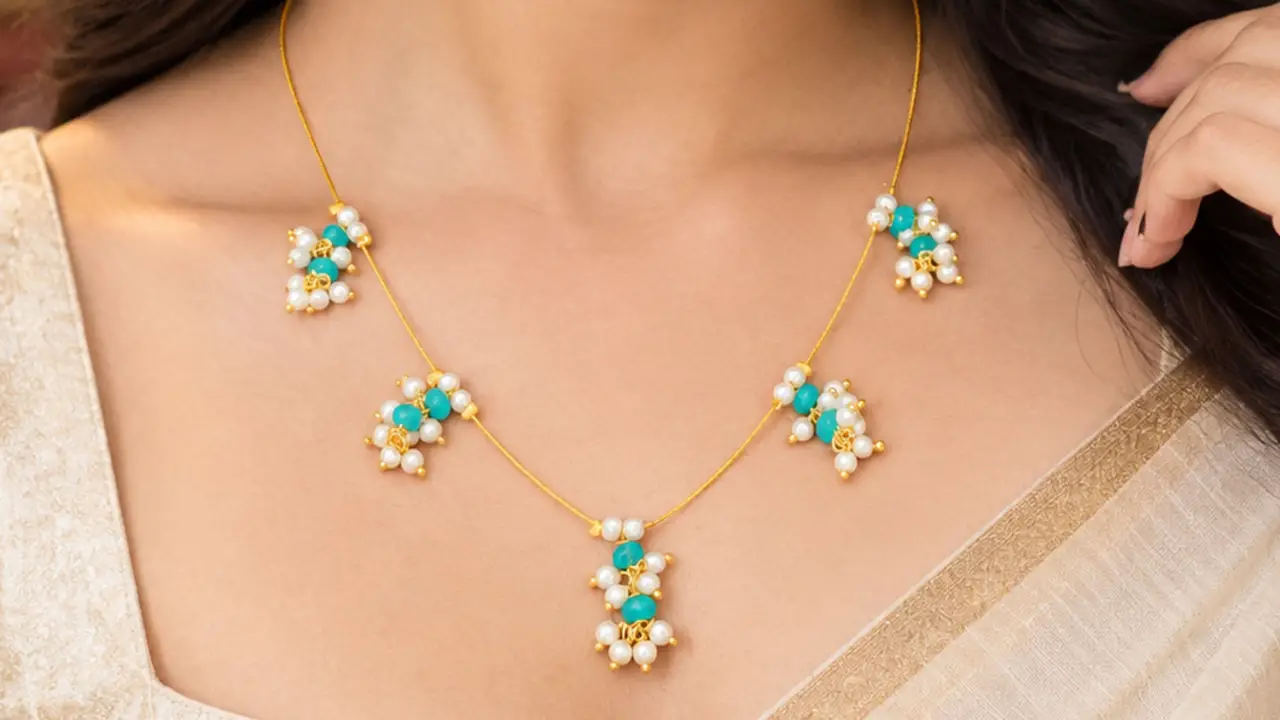
Keep it lighter: a short pendant set, a pearl necklace or small jhumkas, and one or two bangles. Save broad temple haram and large kundan sets for evenings and weddings. A softer silk such as Mysore or Tussar is easiest in daytime.
What necklace length suits a silk saree?
Short to medium lengths suit most silk sarees, since the pallu and border already fill the chest. Choose the length from your blouse neckline, and avoid a long chain that rests on a wide border. A longer necklace works with a plain pallu.
Sources
- Varanasi district administration: Banarasi saree (handloom jacquard, zari ornamentation, motifs, Geographical Indication certificate 2009)
- Kancheepuram district administration: Kancheevaram silks and sarees (contrast borders, pallu, body woven separately and interlocked)
- Sahapedia: An introduction to the handlooms of Maharashtra (Paithani, pit loom, peacock pallu)
- Drishti IAS: Patan Patola (double ikat, Geographical Indication 2013)
- Wikipedia: Tussar silk (wild Antheraea silkworms, coarser texture, natural warm shade)
- Karnataka Silk Industries Corporation: Mysore silk Geographical Indication application (crepe-de-chine and georgette base, zari borders)