A maang tikka is the one piece of jewellery that changes how your whole face looks in photographs, and it is also the one that gives the most trouble. It slides sideways, it tugs at thin hair, or it sits so low that it covers the middle of your forehead.
This guide answers how to wear a maang tikka in the situations people actually ask about: open hair, a bun or braid, short or thin hair, a side parting, bangs, different face shapes and forehead heights, and different outfits. It ends with a simple way to pin one so that it stays put through a long function.
Short answer
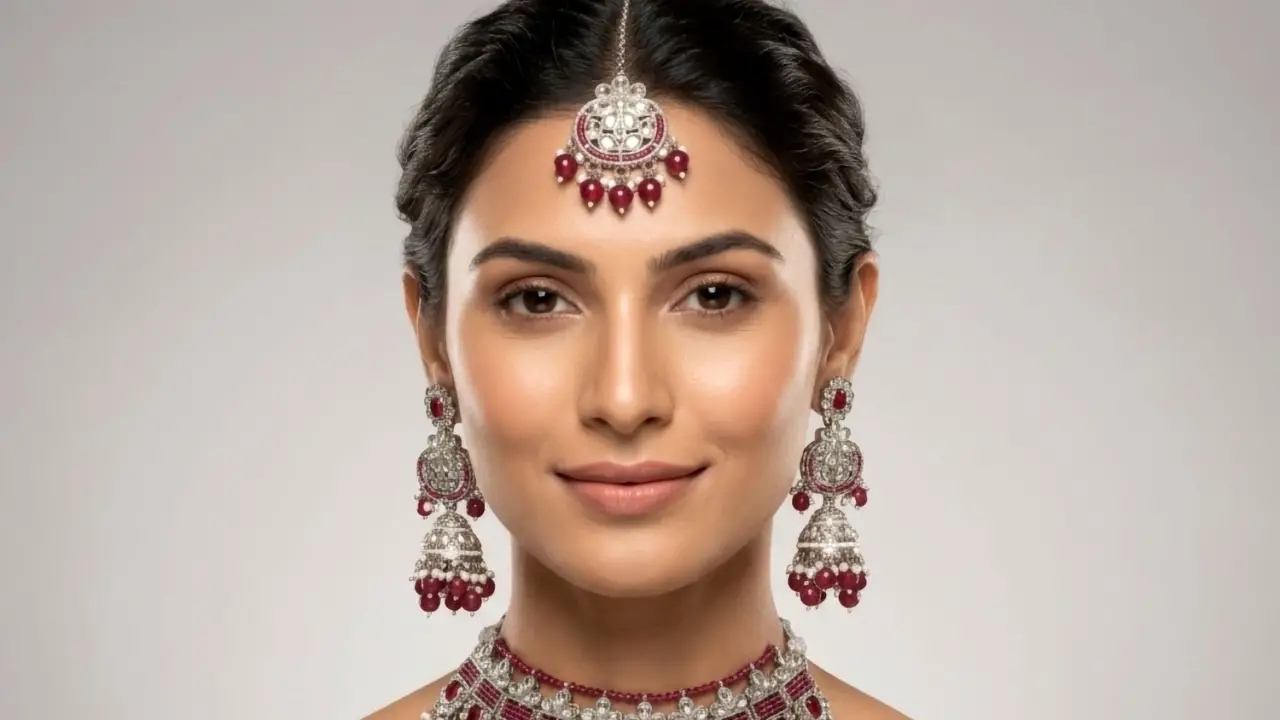
Wear a maang tikka with the hook pinned into the hair at the centre parting and the pendant resting at the centre of your forehead. With open hair choose a lighter tikka and anchor it with a pin. With a bun or braid, heavier pieces sit more securely.
Key takeaways
- The pendant sits at the centre of the forehead and the hook goes into the hair at the parting, so the parting decides everything.
- Light tikkas suit open, thin or short hair. Heavy and bridal tikkas suit buns, braids and pulled-back styles.
- Face shape and forehead height are about the length and width of the drop, and they are options to try rather than rules.
- A tikka that slips is usually pinned into too little hair. Anchor it with two pins and a small twist of hair.
- Choose one centrepiece. If the tikka is bold, keep the earrings and necklace quieter.
What a maang tikka is and where it sits
A maang tikka is a head ornament with a pendant at one end and a hook or pin at the other. The hook fastens into the hair at the centre parting, and the pendant falls on the centre of the forehead. Utsavpedia describes the ornament as hanging from the hairline, and it can be worn with a middle parting or with other hairstyles.
Two things decide how a tikka wears. The chain length decides where the pendant lands, and the pendant weight decides how much hair is needed to hold it.
The hairstyle chart at a glance
| Hairstyle | What works | How to fix it in place | Think twice about |
|---|---|---|---|
| Open, straight or wavy hair | A light, slim tikka with a small pendant | Pin into a small plait or twist at the parting | A very heavy pendant that pulls the hair flat |
| Bun or juda | A medium or heavy tikka, bridal styles | Pin the hook deep, then add a second pin | A tiny pendant that disappears against the volume |
| Braid or pulled-back hair | A tikka with a longer chain and a rounder pendant | Pin into the section just behind the hairline | A short, stiff chain that stands away from the forehead |
| Short hair | A light tikka with a short chain | Use a clip or two crossed pins | A long chain that needs a lot of hair to hold it |
| Thin hair | Light, minimal pendant | Two crossed pins and a small backcomb | Heavy kundan or pearl clusters |
| Side parting | A tikka with a hook long enough to reach the new parting | Move the hook to the parting line, not the centre | Forcing the pendant to the centre with the hook off the parting |
| Bangs or fringe | A short chain, or pin the fringe back | Sweep the fringe aside and secure it first | A pendant that sits over loose fringe and gets tangled |
The sections below explain the reasoning, so you can adapt the chart to your own hair.
How to wear a maang tikka with open hair
Open hair is the style that makes people nervous, because there is no bun to hold the weight. The answer is to choose a tikka whose pendant is small and light, and to pin it into a few strands rather than a single hair.
Part your hair where you want the hook to go. Take a thin section from either side of the parting, twist them together once, and slide the hook under that small twist. A second pin through the hook loop and into the base of the twist stops the tikka from rotating. Then let the rest of your hair fall as usual.
Picture a sangeet where you will be dancing for a few hours in open, wavy hair. A slim tikka with a single teardrop and a short chain will keep its place far better than a broad medallion, and it still shows clearly in photos.
Maang tikka with a bun, juda or braid
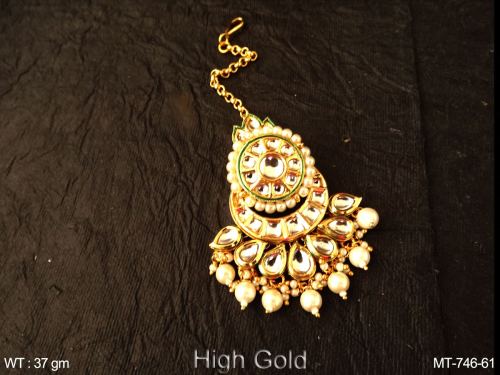
A bun, juda or braid gives you a firm base, and this is where heavier and bridal tikkas work best. The hair is pulled back, the forehead is clear, and the tikka becomes the centre of attention.
Pin the hook into the hair just behind the hairline, and add a second pin so that the weight is shared. If your braid or bun is high, check that the chain is long enough for the pendant to reach the forehead without pulling the hook forward.
A bridal-weight kundan tikka with pearl hangings looks balanced against a bun, because both have volume. If you are choosing for a wedding function, look at pieces made for bridal looks, and keep the earrings and necklace in the same colour family.
Maang tikka for short or thin hair
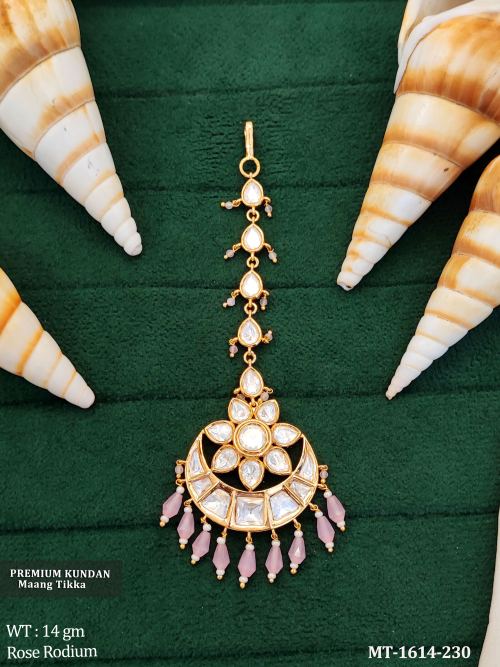
Short and thin hair give the hook very little to hold. Choose a light tikka with a short chain and a small pendant, backcomb the parting lightly so the pins have texture to grip, and cross two pins in an X over the hook. A clip-style fastening helps if the piece has one.
With short hair, a small half-updo also works. Pin a section back from the temples and fasten the tikka into it. If a tikka feels heavy after a few minutes, trust that feeling and swap to a smaller pendant before the event.
Maang tikka with a side parting
A tikka is traditionally worn at the centre parting. If you normally part your hair at the side, you have two options. You can shift to a centre parting for the occasion, or you can move the hook to your side parting and let the chain run across the forehead so that the pendant still lands near the centre.
The second option works when the chain is long enough. Try it at home with your outfit before the day, because a chain that is a few centimetres short will make the pendant sit off-centre.
Maang tikka with bangs
Bangs can hide a tikka and snag on its chain. Sweep the fringe aside or pin it back, then fasten the tikka over the secured hair. To keep the fringe in front, choose a short chain and a small pendant.
Maang tikka for your face shape and forehead
You can wear any tikka you like. If you want a little guidance on proportion, these are options to try in front of a mirror, not rules.
| Face or forehead | Options to try |
|---|---|
| Round face | A longer, narrower drop adds a vertical line. A pendant with pointed or teardrop shapes can look balanced |
| Oval face | Most shapes work, so choose by outfit and occasion |
| Long face | A rounder, shorter pendant keeps the proportions even, and a very long drop may make the face look longer |
| Square face | Soft curves, such as a round or oval pendant, can echo the jaw gently |
| Heart-shaped face | A medium pendant with some width at the bottom sits comfortably |
| Big forehead | A longer chain, so the pendant sits lower on the forehead, or a broader pendant |
| Small forehead | A shorter chain and a smaller pendant, so the piece does not cover the space |
Tikka or matha patti: which one to wear?
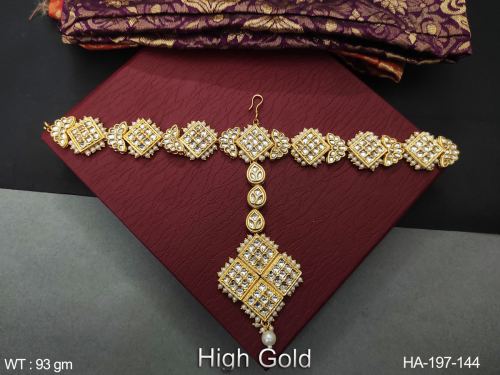
A matha patti adds side chains, so it takes more hair to anchor and shows more of the hairline. It looks full and bridal. A single tikka is lighter and more flexible. If you are wearing a heavy necklace and large jhumkas, a single tikka is usually the balanced choice. If your outfit is simple, a matha patti can be the centrepiece.
Which outfit suits which tikka
| Outfit | Tikka style | Keep quieter |
|---|---|---|
| Bridal lehenga | Heavy kundan or full-stone tikka, sometimes a matha patti | Layer fewer necklaces |
| Silk or Banarasi saree | Medium tikka with pearls, kundan or antique work | Earrings in a similar tone |
| Anarkali or salwar suit | Slim tikka with a small pendant | The necklace |
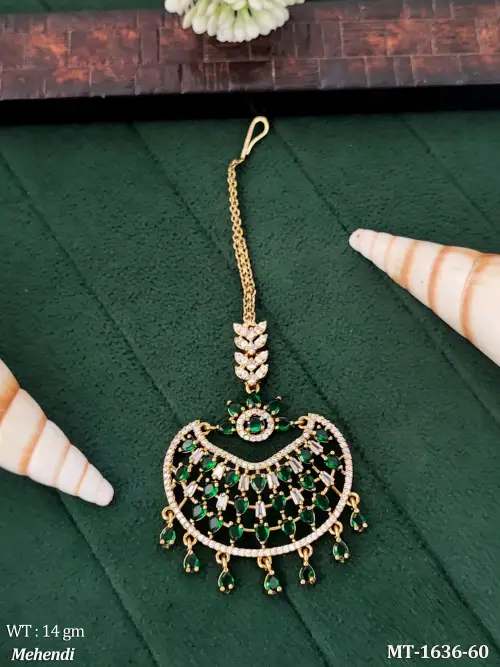
| Contemporary lehenga or indo-western | Stone-studded or American diamond tikka | Bangles and rings |
| Everyday festive wear | Minimal pendant on a short chain | Everything else |
If your outfit is already ornate, with a heavy dupatta or an embroidered border near the face, choose a simpler tikka and let the outfit lead. For a fuller look at pairing jewellery with outfits, see our colour guide for sarees and lehengas.
How to pin a maang tikka in five steps
- Finish your hair first.
Style, set and spray your hair before touching the tikka, so that products do not land on the stones.
- Find the parting and the forehead centre.
Look straight into a mirror and note where the pendant should rest on the centre of your forehead.
- Make a small anchor.
Twist a thin section of hair on either side of the parting, so the hook has something to grip.
- Slide the hook under the twist.
Push it in along the parting, then add a pin through the hook loop and into the base of the twist.
- Add a second pin and test.
Cross a second pin over the first, then turn your head and tilt it down to check that the pendant stays centred.
Common mistakes to avoid
- Wearing it too low. The pendant should rest on the centre of the forehead and not hang down between the brows.
- Too many centrepieces. A big tikka, big jhumkas and a statement necklace compete, so choose one lead. Our guide to jewellery for haldi, mehendi and sangeet shows how to balance a look across functions, and the guide to jewellery without piercing covers naths and jhumkas.
- Skipping a test run. Wear it at home with the outfit for half an hour and fix anything that moves.
Where to start looking
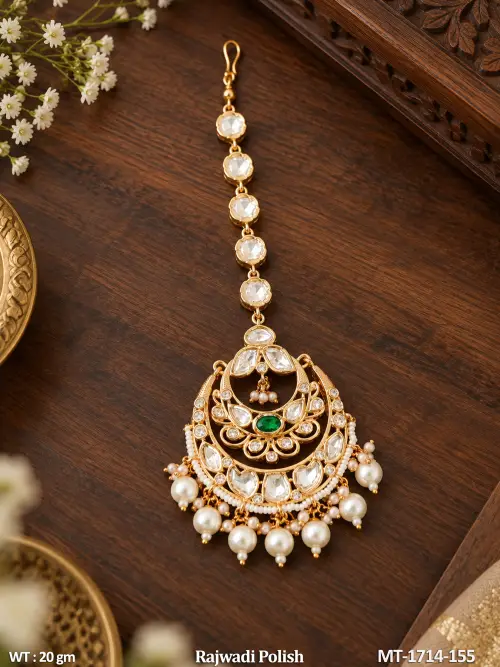
Most of the options above are in a few collections. Maang tikka lists single tikkas in kundan, antique, pearl and stone styles. Maang tikka earrings are sets with matching earrings. Hair accessories include matha patti, juda pieces and hair chains, and dulhan sets are made for bridal looks. If a piece does not suit you, our returns policy allows returns within 2 days.
Frequently asked questions
Where exactly does a maang tikka go?
The hook goes into the hair at the centre parting, and the pendant rests at the centre of the forehead. If it lands between the eyebrows, the chain is too long. If it sits up in the hair, the chain is too short.
How do you wear a maang tikka with open hair?
Choose a light tikka with a small pendant. Twist a thin section of hair on each side of the parting, slide the hook under it, and add a second pin. This keeps the weight on a small plait of hair, so it stays steady while the rest falls free.
Can I wear a maang tikka with short or thin hair?
Yes. Pick a light tikka with a short chain, backcomb the parting lightly and use two crossed pins, or a clip-style fastening if the piece has one. Heavy pendants pull on thin hair, so a minimal design is usually the more comfortable choice.
How do I wear a maang tikka with a side parting?
Either switch to a centre parting for the occasion, or fasten the hook at your side parting and let the chain run across the forehead. The pendant should still land near the centre, so check that the chain is long enough before the event.
Which maang tikka suits a round face?
Many people with a round face like a slightly longer, narrower drop, because it adds a vertical line. Teardrop and pointed shapes are worth trying. These are options, not rules, so photograph two styles and keep the one that feels comfortable.
What tikka suits a big or a small forehead?
With a big forehead, a longer chain lets the pendant sit lower, or you can choose a broader pendant. With a small forehead, a shorter chain and a smaller pendant leave breathing space. Try both lengths with your hairstyle to see what looks balanced.
Can I wear a maang tikka with bangs?
Yes. Either sweep the fringe to one side and pin it back before fastening the tikka, or choose a short chain and a small pendant that sits above the fringe. A long chain can snag on loose strands and drag the fringe.
What is the difference between a maang tikka and a matha patti?
A maang tikka has one central pendant on a chain. A matha patti keeps the central pendant and adds side chains along the hairline, so it frames the face. It is fuller and takes more hair to anchor, so it is usually chosen for bridal and festive looks.
Can I wear a maang tikka with a hijab or dupatta?
That is a personal choice. Some people clip a small tikka at the front edge of a dupatta or scarf so the pendant rests on the forehead. Use a pin that grips fabric, and choose a light pendant so the cloth does not slip.
How do I stop my maang tikka from slipping?
Use two crossed pins instead of one, and give the hair some texture at the parting. Twist a thin section of hair to anchor the hook. If it still moves, the pendant may be too heavy for your hairstyle, and a lighter tikka will sit better.