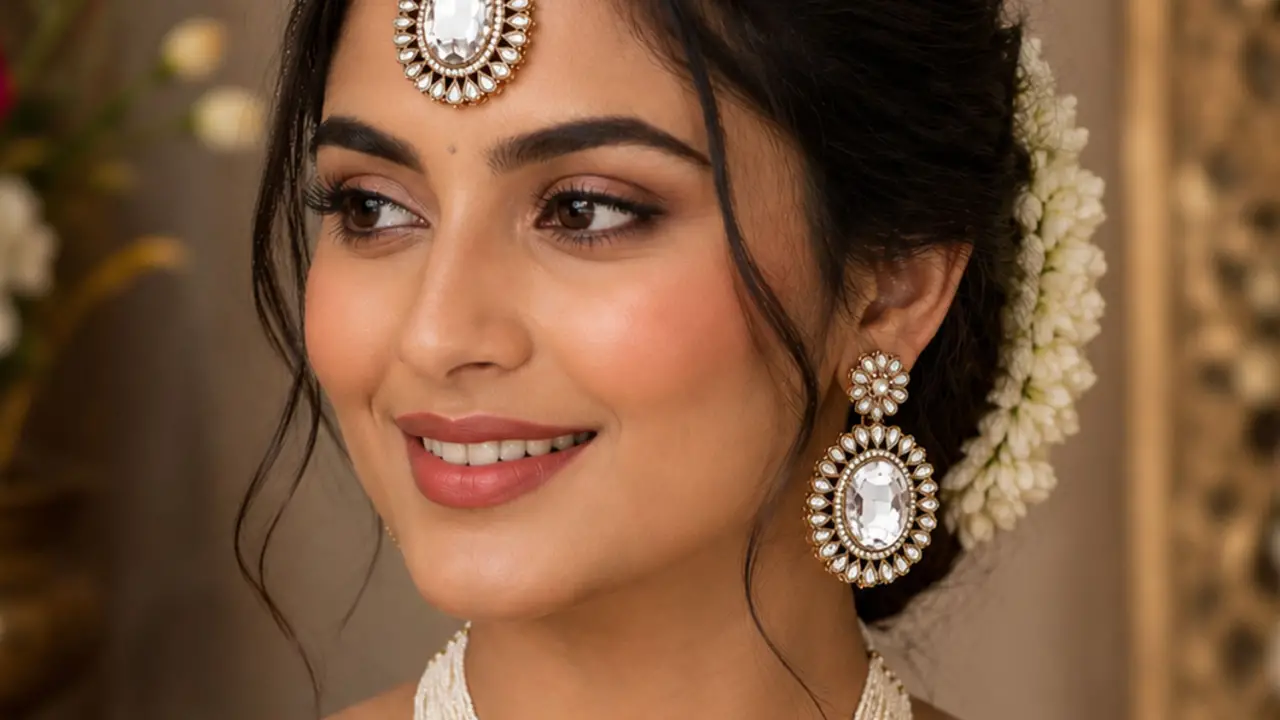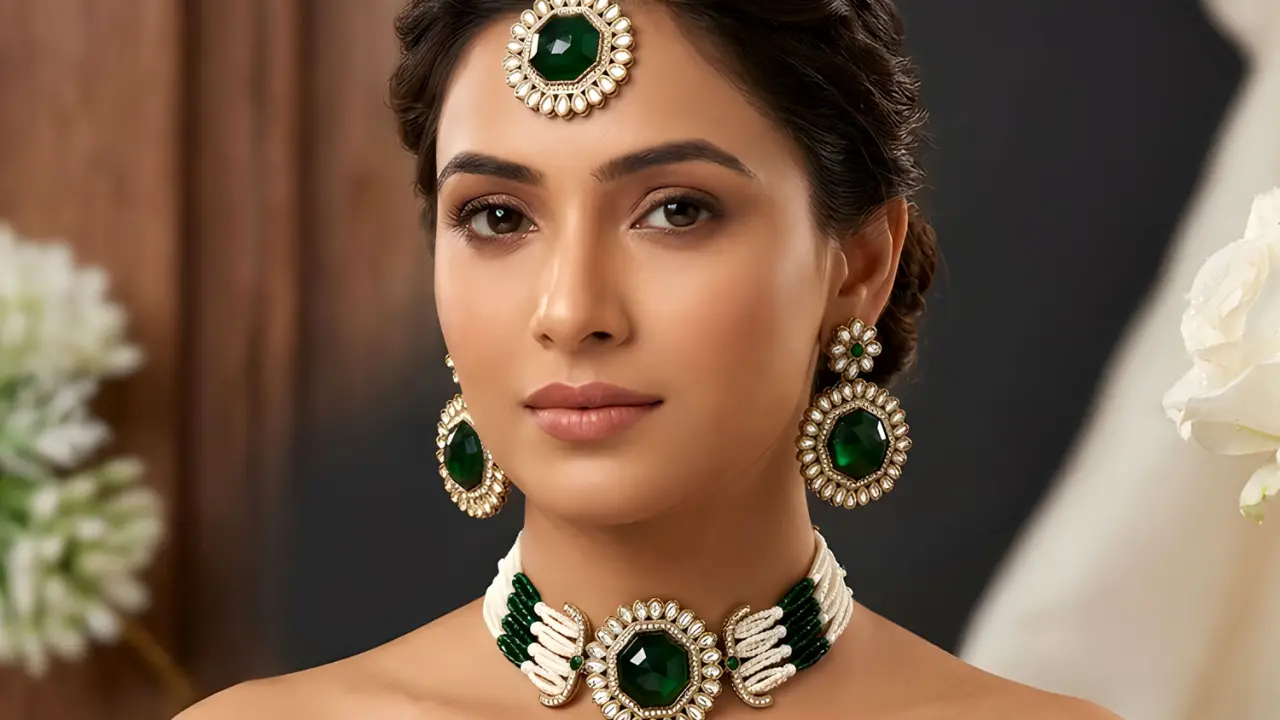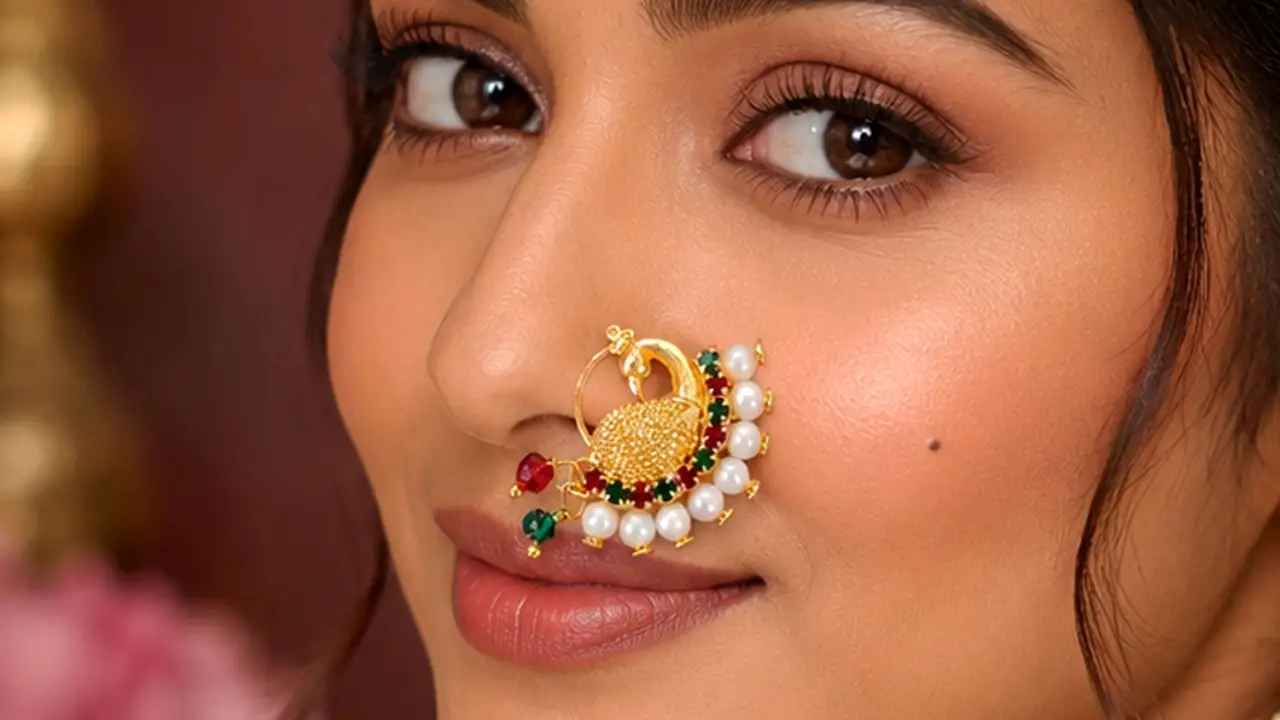
An engagement and a reception sit at either end of a wedding, and they ask different things of your jewellery. The engagement is close and quick: a ring exchange, family around you, hands photographed again and again. The reception is the big evening, with stage lights, flash and a long night of standing and dancing. Dressing for both with the same set rarely works well.
This guide covers jewellery for an engagement and for a reception, whether you are the bride, her sister, the groom's family or a guest. It does not repeat a full bridal checklist, because the two events call for a lighter and more flexible plan. We also say plainly what we do not sell: the ring that is exchanged is yours to choose elsewhere, and everything around it is what this page is about.
Short answer
For an engagement, choose one clear necklace or earring statement, keep the hands tidy because the ring exchange is photographed up close, and match the metal tone to the outfit. For a reception, go bolder and brighter, with sparkle that carries under evening lights. Share one or two pieces between both events.
Key takeaways
- The engagement is a hands-and-face event, so a neat wrist and a clear earring matter more than a heavy necklace.
- The reception is an evening event with flash photography, so faceted, light-catching stones read better than matte finishes.
- Pick the necklace by the neckline of the outfit, then let one other zone lead.
- Guests dress lighter than the bride's side, and skip full bridal sets and red when the bride wears it.
- Plan one shared piece, usually the earrings, so two events do not need two complete sets.
Engagement and reception: what is different
The clearest way to choose is to ask when the event happens, what the lighting is like and who will be looking at your hands and face. Timing varies by family, so treat this table as a general guide.
| Engagement | Reception | |
|---|---|---|
| Usual setting | A smaller gathering, often at home, a hall or a banquet, in the day or evening | The largest event of the wedding week, usually in the evening |
| What gets photographed | The ring exchange, hands, the couple and the families | The stage, the entrance, dancing, full-length looks |
| Light | Often daylight or soft indoor light | Stage lights and camera flash |
| Mood of the jewellery | Polished and personal | Bold, glamorous, brighter |
| Outfit | Lehenga, saree, gown or Indo-western set | Heavier lehenga, saree, gown or saree-gown |
Retail style guides agree that the reception is the moment for your most statement-style jewellery, and they mostly write for the bride. We cover the other half of the room as well.
The engagement: dress the hands first
At an engagement, the moment everybody remembers is the ring exchange. That moment is photographed from close range, so your hands are in the frame as much as your face. Plan the wrists before the necklace.
- Keep the ring hand clear. Wear no other rings and no wide cuff that crowds the ring finger. A clean hand lets the ring show.
- Choose a wrist piece that sits still. A single kada or a matched pair of bangles looks tidy in photographs. A big stack of loose bangles slides down toward the hand as you move and clatters during the exchange.
- Match finish across the hand. If the ring is a warm yellow tone, a gold-tone kada looks coordinated. If it is white-toned, a stone-set white-finish kada looks calmer.
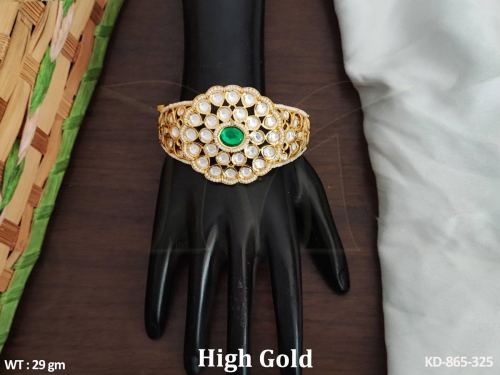
These suggestions come from how close-range photographs behave, so treat them as our view. Browse the full range under kada and bracelets.
Jewellery by outfit: lehenga, saree, gown and Indo-western
Outfit first, then the necklace. The outfit decides how much room the jewellery has, and the neckline decides where the necklace sits.
| Outfit | Necklace logic | What should lead |
|---|---|---|
| Embroidered lehenga | Short set or choker, kept lighter | Earrings and maang tikka |
| Simple lehenga | Choker with a longer layered strand | The necklace |
| Silk or Banarasi saree | A short or medium set that clears the blouse neck | The necklace or the earrings |
| Chiffon, organza or pastel saree | Small drops or a slim pendant set | Earrings |
| Strapless or off-shoulder gown | A choker or a collar-length set | The necklace |
| High-neck gown | No necklace | Bold earrings and a bracelet |
| Indo-western set or saree-gown | A layered, modern chain or a sleek set | One bold piece, kept sleek |
These pairings follow the same logic you will find in most outfit guides: a heavily worked outfit wants a lighter neckline, a plain one can carry a bolder piece. For the colour side, our colour guide for sarees and lehengas sets out metal tones and stone colours. For a blouse that changes the neckline, the guide to necklaces for different necklines helps.
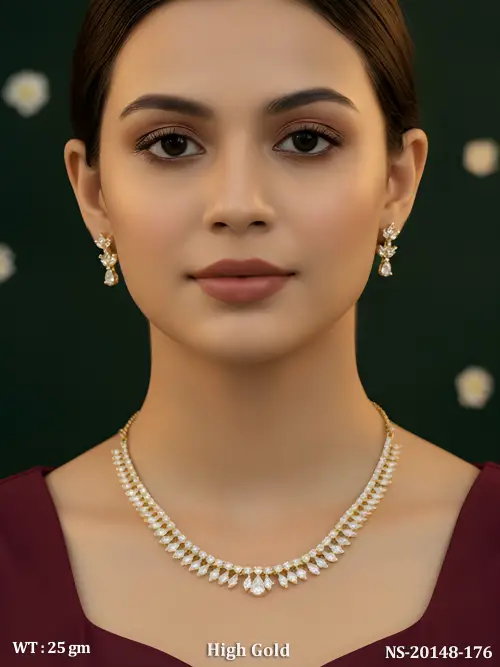
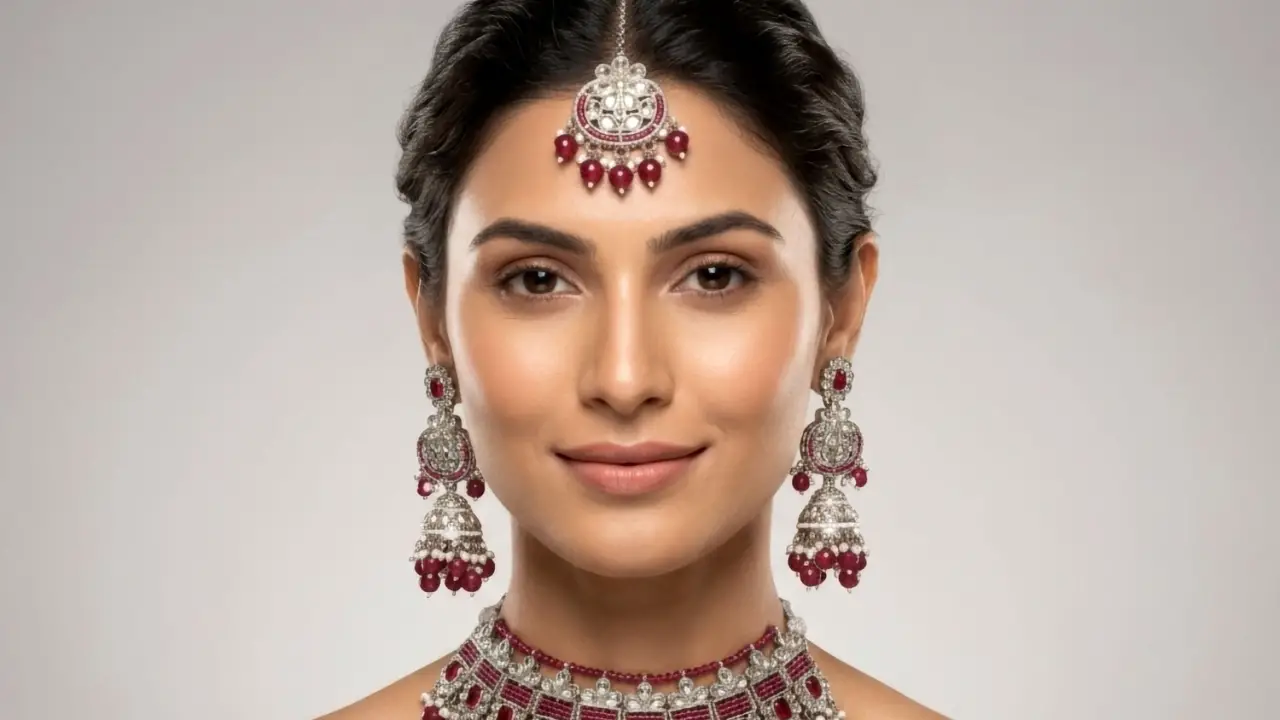
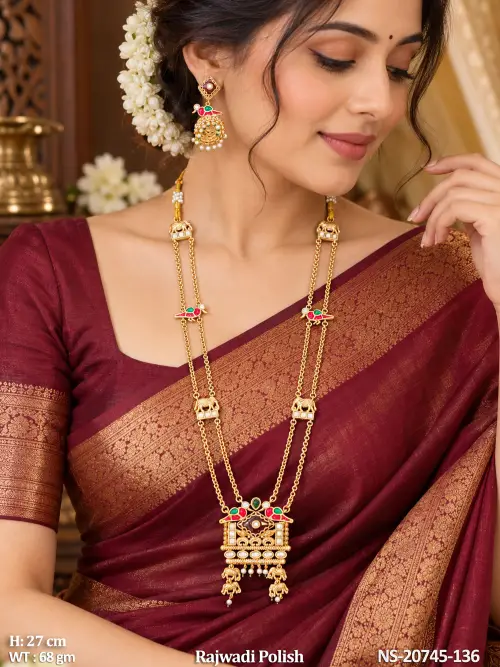
A sleek set such as the one above suits a gown or a plain saree, where the lines of the outfit are the show. Anything with a lot of detail belongs on a plain outfit.
Three engagement looks to copy
Each of these is a worked example, not a record of a real event.
An embroidered lehenga in the day
Imagine a pastel lehenga with detailed embroidery. A short choker, medium jhumkas and a small maang tikka give the face the focus, and a single kada keeps the hands tidy. Our guide to wearing a maang tikka covers placement.
A silk saree in the evening
Picture a deep green silk saree with a gold border. A medium antique-style set, matching earrings and four bangles of one finish suit it. The border already carries shine, so the jewellery stays in proportion.
A gown with a bare neckline
Think of a fitted gown with a strapless neckline. A choker with drops frames the collarbone and the earrings can stay medium. Nothing else is needed.
The reception: bolder, brighter, built for flash
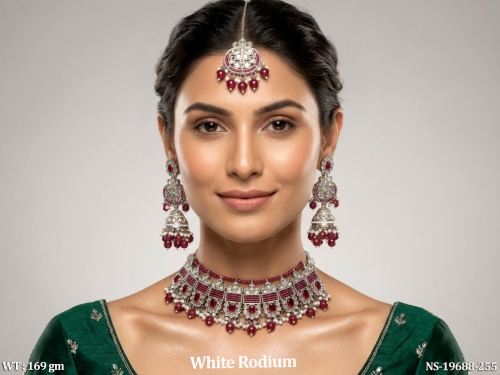
A reception is an evening event, and evening light changes what jewellery looks like. Under stage lights and flash, faceted stones throw light back, while matte finishes absorb it. That is why many reception looks use white-toned, stone-set pieces. Stones that catch the light tend to show up in photographs, and they carry across a hall.
- Go bigger on the earrings. Chandbalis, chandeliers and long jhumkas reach the camera when the necklace is hidden by a dupatta or a hairstyle.
- Layer with care. A choker plus one longer strand adds depth. Three necklaces add clutter.
- Pick one statement piece. If the earrings are loud, keep the necklace calmer.
- Think about movement. You will dance, hug and sit on a stage. Choose earrings you can wear for hours, and see our guide to earrings for your face shape for balance.
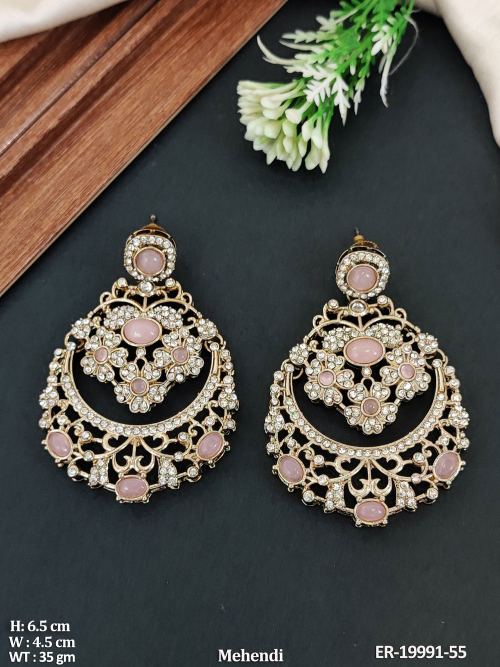
Stone-set white and pastel pieces sit under the heading of AD or CZ jewellery in our catalogue, and you can browse them through the American Diamond and CZ jewellery page. They are artificial stones set in a metal alloy base, and the sparkle comes from the faceting.
Who are you: bride, sister, family or guest?
At a wedding, the right amount of jewellery depends on whose side you are on. The table below is a practical guide, and your family's customs come first.
| You are | At the engagement | At the reception |
|---|---|---|
| The bride | A full look with one clear hero piece | A bolder second look, sharing one piece |
| The bride's or groom's sister | A medium set that does not outshine the bride | Statement earrings and a light necklace |
| Mother of the couple | A traditional set in a rich tone | The same set, restyled with fresh earrings |
| A guest | One statement piece | One statement piece, a little brighter |
As a guest, avoid a full bridal set and avoid red if the bride wears it. For more on guest dressing, see our guide to jewellery for an Indian wedding guest. If your event also has a sangeet, the pieces in our haldi, mehendi and sangeet guide may suit that evening better.
Plan to share pieces between the two events
Most people do not need two complete sets. Decide which one piece appears at both events, and change the rest. Earrings are the easiest shared piece, because they look different with a new necklace. A neutral maang tikka or a pair of bangles in a neutral finish can also repeat.
If you want one necklace with options, a pendant that also works alone gives you two looks from one purchase. Browse these under necklace sets.
Comfort for a long evening
Jewellery that looks perfect at 6 pm can feel heavy by 10. Before the event, wear the full look at home for an hour and note what pulls. Check the earring clasp. Check that nothing snags a sleeve or dupatta. Keep a small pouch with spare back clips, because a lost backing ends the night for a good pair of earrings. After the event, wipe each piece with a dry soft cloth. Our care guide for kundan, pearl, AD and antique jewellery has the details.
A note on the ring itself
We sell artificial fashion jewellery, and we do not sell engagement rings. The ring that is exchanged is usually chosen by the couple and their families. Our pieces dress the rest of the look, including the wrist, ears, neck and forehead.
Frequently asked questions
What jewellery should I wear to an engagement ceremony?
Choose one clear statement, either the necklace or the earrings, and keep the wrists tidy because the ring exchange is photographed closely. Match the metal tone to the outfit. A single kada or a matched pair of bangles looks neat in photographs.
What jewellery goes with an engagement lehenga?
For an embroidered lehenga, wear a short choker or set, medium jhumkas and a small maang tikka, and let the earrings lead. For a simple lehenga, you can wear a bolder necklace. Keep the metal tone close to the outfit's embroidery.
What jewellery should I wear with a gown for an engagement?
Match the jewellery to the neckline. A strapless or off-shoulder gown suits a choker or collar-length set. A high-neck gown looks better without a necklace, so wear bold earrings and a bracelet instead.
What jewellery should I wear to a wedding reception?
Go bolder and brighter than the day events. Stone-set pieces that catch the light carry well under stage lights and flash. Wear statement earrings, a choker or layered necklace, and one bracelet. Pick one hero piece so the look stays balanced.
Should I wear different jewellery for the engagement and the reception?
Usually yes, but not an entirely new set. Change the necklace and keep one piece, often the earrings. The reception is brighter and bolder, so a second necklace or a bolder earring makes the two looks feel distinct.
Can I wear artificial jewellery to an engagement or reception?
Yes. Both events are about how a look appears in person and in photographs. Our pieces are artificial jewellery, made in India on a metal alloy base with artificial stones, and they suit both events when matched to the outfit.
What should a guest wear to an engagement or reception?
One statement piece, either a necklace or a pair of earrings, with lighter supporting jewellery. Skip a full bridal set, and avoid red if the bride is wearing it. A reception allows slightly brighter and bolder pieces than an engagement.
What jewellery suits a saree for a reception?
A rich silk or embellished saree suits a medium set with statement earrings. Keep the necklace in proportion to the border and the blouse neckline. A plain saree can take a bolder necklace, and a heavily worked saree is better with lighter pieces.
What jewellery goes with a pastel outfit at an engagement?
Pearls and white-toned stone-set pieces keep a pastel outfit soft. Soft gold-tone also works. Pick one metal tone, and let a single accent stone echo a colour already in the outfit. Avoid heavy, multi-colour sets against pale fabric.
How many pieces of jewellery should I wear for an engagement?
Think in zones: face, neck and wrists. Make one zone the hero and keep the others lighter. A necklace set with earrings and a single kada is enough for most engagement looks, and a tikka is optional.
Do you sell engagement rings?
No. We sell artificial fashion jewellery, including necklace sets, earrings, bangles, kada, bracelets and maang tikka. The ring exchanged at an engagement is usually chosen by the couple and their families. Our pieces dress everything around it.