You find a bangle you love, and then the size menu asks for 2.2, 2.4, 2.6 or 2.8. Most people have heard those numbers and few know what they stand for. Is 2.4 a length, a weight, a wrist size? And why does 2.10 sit above 2.8?
This bangle size chart gives each Indian size in inches, centimetres and millimetres, then shows two ways to find your own number at home. Every figure is approximate, and we say where the charts we read disagree. We have not measured our own bangles, so use this guide to understand the numbers and the product page to check the piece.
Short answer
An Indian bangle size is the inside diameter. Size 2.4 is about 5.7 cm across, 2.6 is about 6.0 cm and 2.8 is about 6.4 cm. To find yours, measure the inside of a bangle that fits, or wrap string round the widest part of your closed hand and divide by 3.14.
Key takeaways
- The number after the point counts sixteenths of an inch, so 2.10 is larger than 2.8.
- Each step up adds about 3 mm to the inside diameter.
- A bangle has to pass over the widest part of your hand, so measure the hand and not the wrist.
- Between two sizes, most guides say to take the larger one.
- Kadas, adjustable pieces and sets each need one extra check, covered below.
Bangle size chart in cm, mm and inches
All the sizes in the chart are inside measurements. "Across" is the distance from one inner edge to the opposite inner edge, and "around" is the inside circle, which is the diameter multiplied by 3.14.
| Indian size | Across (inches) | Across (mm) | Across (cm) | Around (cm) |
|---|---|---|---|---|
| 2.2 | 2 2/16 (2.125) | about 54.0 | about 5.4 | about 17.0 |
| 2.4 | 2 4/16 (2.25) | about 57.2 | about 5.7 | about 18.0 |
| 2.6 | 2 6/16 (2.375) | about 60.3 | about 6.0 | about 18.9 |
| 2.8 | 2 8/16 (2.5) | about 63.5 | about 6.35 to 6.4 | about 19.9 |
| 2.10 | 2 10/16 (2.625) | about 66.7 | about 6.7 | about 20.9 |
| 2.12 | 2 12/16 (2.75) | about 69.9 | about 7.0 | about 21.9 |
Use the table as a guide and not as a promise, because a piece labelled 2.6 can be a few tenths of a millimetre off the chart.
What does 2.4 mean in bangle size?
So 2.4 is two inches and four sixteenths, which is 2.25 inches or about 5.7 cm. Size 2.6 is two inches and six sixteenths. The point is not a decimal point, which is why 2.10 is a bigger bangle than 2.8 even though it looks smaller.
Each step up is two sixteenths of an inch, about 3 mm across. That small gap can decide whether a bangle slides over the knuckle.
Watch for a plain 2.5 in a listing. Two and a half inches is 2 8/16 on this chart, which is size 2.8, so ask the seller what any other number means.
Where the charts we read differ
We read five Indian jewellery size guides. They agree on the inch column, and the differences are small rounding choices.
- Size 2.8 in cm. Most charts give 6.35 cm, one rounds it to 6.4 cm and one lists 6.5 cm.
- Circumference. One chart lists size 2.6 at 19.0 cm, although its own diameter gives about 18.9 cm.
- Seller's own sizing. One maker measures inside the finished, wrapped bangle, so its 2.4 comes out nearer 5.8 cm.
When a listing gives millimetres, trust them over any table.
How to measure bangle size at home
- Close your hand the way you would to slip a bangle on.
Bring the thumb in towards the little finger so the hand is as narrow as it can get.
- Wrap a string or paper strip round the widest part.
This is usually across the knuckles. Do not use a stretchy thread, and do not measure the wrist.
- Mark where the ends meet and measure the length.
Lay the string flat against a ruler and read it in centimetres or millimetres.
- Match it to the "around" column.
Pick the first size whose "around" figure is equal to or larger than your number. If you prefer a diameter, divide your length by 3.14.
Picture a hand that measures 18.4 cm round the knuckles. The 2.4 row (about 18.0 cm) is too small, and the 2.6 row (about 18.9 cm) clears it, so this hand starts at 2.6.
Method two: measure a bangle that already fits
If you own a rigid bangle that slides on comfortably, lay it flat and measure straight across the inside, edge to edge through the centre, leaving out the thickness and any stones on the rim. If it is slightly oval, use the longest distance. Then find the nearest figure in the "across" column.
Which size for a small, medium or large hand?
Seller guides sometimes call 2.2 extra small and 2.8 large, but hands differ in width and change through the day, so we would go by the knuckle measurement. The table is our own arithmetic from the "around" column, and one guide sets its hand ranges almost the same way.
| Closed hand round the knuckles | Starting size |
|---|---|
| Up to about 17.0 cm | 2.2 |
| Over 17.0 up to about 18.0 cm | 2.4 |
| Over 18.0 up to about 18.9 cm | 2.6 |
| Over 18.9 up to about 19.9 cm | 2.8 |
| Over 19.9 up to about 20.9 cm | 2.10 |
Between two sizes: which one to choose
Every guide we read gives the same advice: take the larger size. A slightly loose bangle can be worn, while one that is too small cannot pass the hand. Glass and other rigid bangles have no give, so the extra step matters most for them.
- Measurement ends in .8 or .9. One guide says to take the next size up straight away.
- Wider knuckles than wrist. Size for the knuckles. If it then feels loose, a kada that opens may suit you better.
- Hands change through the day. Several guides say hands can be larger in the evening or in heat, so measure twice and use the larger number.
- Still too snug. One guide suggests a little soap or oil on the hand to help a bangle over the knuckles. Do not force it, and ask the seller if it will not go on.
For a long function day, our guide to jewellery for haldi, mehendi and sangeet covers the order of dressing.
How to read the size options on OyeKudiye
On our bangle pages the size options read 2 X 2, 2 X 4, 2 X 6, 2 X 8 and 2 X 10. These are the same labels as 2.2, 2.4, 2.6, 2.8 and 2.10 in the chart above. When we checked our current bangle listings on 18 November 2026, 2.4 and 2.6 were offered on most in-stock bangles, 2.8 on nearly half, 2.2 on about a third and 2.10 on only a few. We did not find 2.12 or children's sizes. Stock changes, so choose the size on the page itself.
We have not measured our bangles ourselves, so the listing's size label is the one that counts. If you sit between two options, or need a size that is not listed, ask us on the contact page before you order. Our bangles section has the full range.
Kada and adjustable bangles
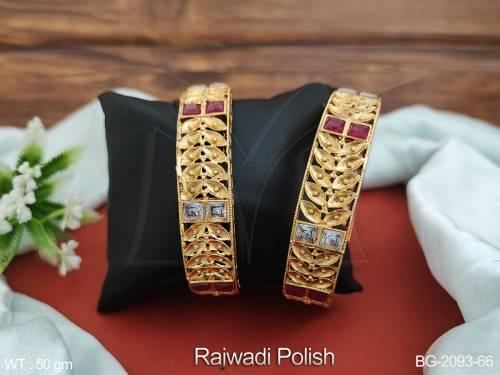
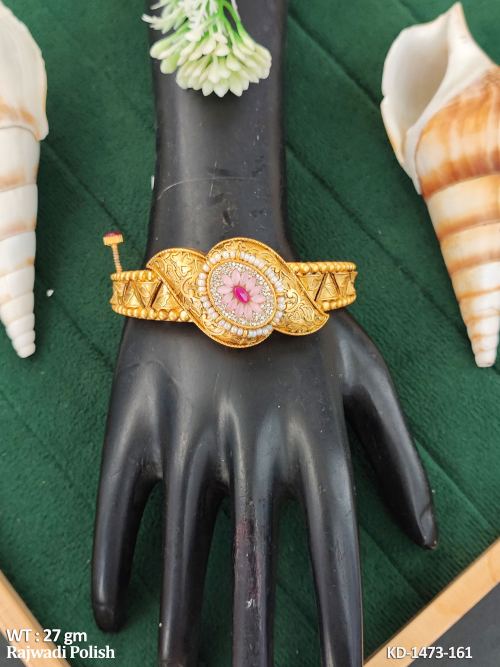
A kada is a thicker, usually single bangle, and a rigid one follows the size rules above. One source says a wide kada, above roughly 15 mm, can feel tighter than its size suggests, so a half size more may help. Others say a kada that opens on a screw or hinge does not pass over the knuckles, so you can choose by the wrist, possibly one or two sizes smaller. Sources differ, so check the maker's size note.
None of the guides we read gave a rule for an adjustable piece, one with an open end or a screw that tightens. It can forgive a half size, but a very small or very large hand can still fall outside its range, so read the listing for the opening and measurements. Our kada range includes adjustable pieces.
Sets and stacks: keep one size
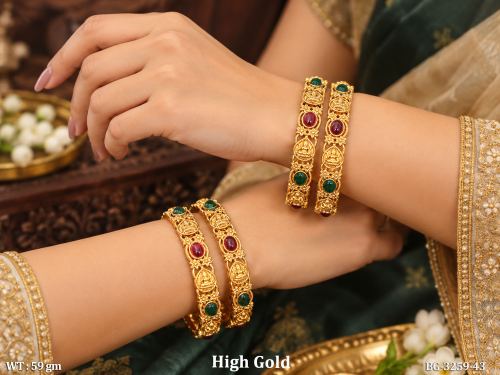
A set of two, four or six bangles shares one size, so your number applies to every bangle in it. One guide says to keep a stack at the same size so it sits evenly, and to put the smaller bangle nearest the hand if you mix sizes.
For colours, see our guide to jewellery for saree and lehenga colours, and to keep a set tidy, see how to store artificial jewellery without tangles.
Children's bangle sizes
Children's bangles use a separate, smaller run, usually written 1.8, 1.10, 1.12 and so on up to 2.0 before the adult sizes begin. The age guides we read do not agree, and hands of the same age differ a lot. Measure a bangle that already fits the child and choose the next size up, because small hands change quickly. We do not currently list children's sizes.
If the bangle does not fit
Do not force a bangle over the hand. If it is too small, stop and measure again, and if it is too large, a smaller size or an openable kada is usually the answer. Our returns policy allows returns within 2 days, so read it before you order. Measuring twice, on two different days, is the easier route.
If you also need ring or anklet sizes, the sibling guide is our ring, anklet and necklace length size chart.
Where to start looking
Once you have your number, browse bangles and filter by the size you measured. Check the size options on each page, because stock changes.
Frequently asked questions
What does 2.4 mean in bangles?
It means the inside of the bangle is two inches and four sixteenths of an inch across, which is 2.25 inches or about 5.7 cm. The number after the point counts sixteenths, not tenths, so 2.10 is bigger than 2.8. Sellers also write it as 2-4 or 2 X 4.
What is bangle size 2.4 in cm?
About 5.7 cm across the inside, which is 57.2 mm, and about 18.0 cm round the inside circle. Sellers round it slightly differently, and one maker measures inside the finished bangle, so check the millimetres on the product page where they are given.
Which size is 2.6 in bangles?
Size 2.6 is two inches and six sixteenths, about 2.375 inches, 60.3 mm or 6.0 cm across the inside. It is one step larger than 2.4 and one step smaller than 2.8, and each step is about 3 mm. Charts round the metric figure slightly differently, so treat 6.0 cm as approximate.
How do I measure bangle size at home without a bangle?
Close your hand, with the thumb tucked towards the little finger, and wrap a string round the widest part, usually the knuckles. Mark it, measure it on a ruler, and match the length to the "around" column of the chart. Divide by 3.14 if you want the diameter instead.
How do I measure bangle size with a bangle I already own?
Lay a rigid bangle that fits you flat and measure straight across the inside, from inner edge to inner edge through the centre, in millimetres. Ignore the thickness and any stones on the rim, then match the result to the nearest figure in the "across" column.
If I am between two bangle sizes, which should I choose?
Most guides say to take the larger size. A slightly loose bangle can be worn, while a bangle that is too small cannot pass the hand, and glass or rigid pieces have no give. One guide says to go up if your measurement ends in .8 or .9. Ask the seller if you are unsure.
What is the difference between 2.2 and 2.4 in cm?
About 0.3 cm across the inside, or roughly 3 mm. Size 2.2 is about 5.4 cm and 2.4 is about 5.7 cm. Round the inside circle the gap is about 1 cm, which can decide whether a bangle clears the knuckles.
Which bangle size is right for a small, medium or large hand?
Go by your own knuckle measurement and not by a label. As a loose guide, a closed hand of up to about 17 cm round the knuckles starts at 2.2, about 18 cm at 2.4, about 19 cm at 2.6 and about 20 cm at 2.8. Treat these as ranges and measure twice.
How do I measure bangle size for a kada?
A rigid kada sizes like a bangle, so measure the knuckles or a fitting bangle. Wide kadas can feel tighter, so one source suggests half a size more. A kada that opens on a hinge or screw may fit a size or two smaller, but sources differ, so read the maker's size note.
Do adjustable bangles need a size?
They still have a range. An adjustable bangle can forgive about a half size, which suits gifts and uncertain measurements, but a very small or very large hand can fall outside it. Read the listing for the opening and measurements.
What are the bangle sizes for children?
Children use a smaller run, usually 1.8 to 2.0 before the adult sizes start. Age guides from different sellers do not agree, and hands of the same age differ. Measure a bangle that already fits the child and take the next size up. We do not currently list children's sizes.
What should I do if the bangle does not fit?
Do not force it over the hand. Measure again on another day, and check the size you ordered against the product page. Our returns policy allows returns within 2 days, so read it first. If you are close, an openable kada or a size up may be the answer.
Sources
- House of Falguni: Bangle size chart (sizes 2.2 to 2.12 in inches, mm and cm; sixteenths of an inch; hand and bangle methods; the maker's own sizing note)
- Taasha Craft: Bangle size guide (the same size chart; children's sizes; between-size advice)
- Kannika Bangles: Indian bangle size chart (sizes in sixteenths; knuckle method; screw-open kadas)
- Jaipur Gems: Bangles size chart (inside diameter and circumference; wide kadas; children's age ranges)